After the event: results, survey and the next competition
The week after a competition is when entries for the next competition are won or lost. Athletes are still talking about it, sponsors are deciding whether to come back, and everything that went wrong is still fresh enough to fix. This guide is that week, day by day, with the survey questions and the sponsor report ready to copy.
It follows the example every Team Aretas resource uses: 120 athletes, 8 lanes, one day, finishing with the awards at 20:15.
The short answer
- Publish the final results the same night, and the photos within a few days.
- Send one thank-you email the next day with the results, the photos and a survey of 10 questions.
- Open early-bird entries for the next competitions within two weeks, to athletes who have just competed.
The week after
Each job, and when to do it:
| When | What | Who |
|---|---|---|
| The night of the event | Final results published, once the head judge has signed them off | Organiser |
| Day 1 | Thank-you email: results, photos to come, the survey | Organiser |
| Day 3 | Photos published, and athletes told | Organiser |
| Day 4 | Survey reminder to anyone who has not answered | Organiser |
| Day 5 | Sponsor reports sent | Organiser |
| Day 7 | Debrief with the head judge and staff; survey closes | Organiser |
| Day 7 to 14 | The next competition's date announced and the early bird opened | Organiser |
Results
Publish the final leaderboard the night of the event, as soon as the head judge has signed the scores off. Athletes check it on the drive home, and a result that changes after the podium photos is the one thing worse than a late one.
- Correct mistakes in the open. If a score changes after publishing, tell the athletes it affects, and say why.
- Leave the results up for good. Athletes entering your next competition look at this board to choose a category.
The thank-you email
One email, the day after, to every athlete. It does four jobs:
- Thanks them, and the judges, staff and sponsors by name.
- Links to the final results, and says when the photos will be up.
- Asks for 2 minutes for the survey.
- Gives the next competition's date, if you already have it.
The athlete survey
Ten questions, which take about 2 minutes. Not sure what to use? Google Forms is free. Send it with the thank-you email and close it after a week:
| No. | Question | Answer |
|---|---|---|
| 1 | How likely are you to recommend this competition to a friend? | 0 to 10 |
| 2 | How did you hear about it? | Choice |
| 3 | Was your category the right level for you? | Too easy, right, too hard |
| 4 | How would you rate the workouts? | 1 to 5 |
| 5 | How fair was the judging? | 1 to 5 |
| 6 | Did the day run to time? | Yes, mostly, no |
| 7 | Did you know what was happening before the day? | Yes, mostly, no |
| 8 | Was it good value for the entry price? | 1 to 5 |
| 9 | What one thing should we change? | Free text |
| 10 | Will you enter our next competition? | Yes, maybe, no |
Question 1 is the one to watch from one competition to the next. Question 3 tells you which categories to split or merge, and question 9 is where most of the next competition's improvements come from.
Photos
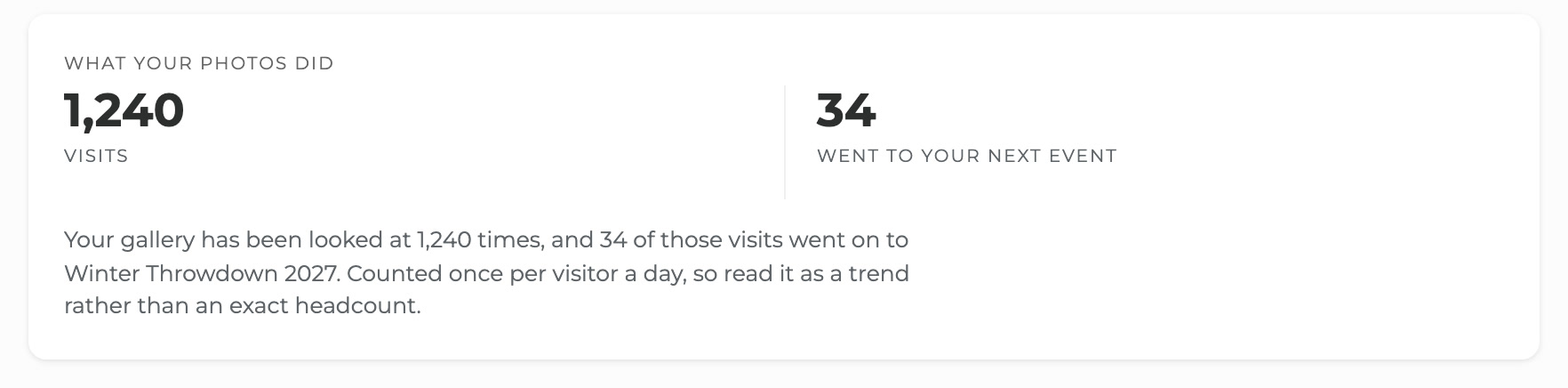
Photos are what athletes share, and every share is an advert for your next competition. Publish a selection within a few days, while people are still looking for them, and tell every athlete when they are up. A gallery is also the one place that keeps working for you: here, the photos from one competition sent visitors on to the organiser's next event:
The sponsor report
One page per sponsor, by day 5, while the event is fresh in their mind:
| Section | What to include |
|---|---|
| The event | Date, venue, 120 athletes, and how many spectators came |
| Where they appeared | Every place their name or logo was: the floor, the screens, the emails, the prizes |
| The numbers | Visits to the competition page, social posts and their reach, gallery views |
| Photos | Three or four photos with their branding in shot |
| The next competition | The date, and what you would offer them again |
Only report numbers you can show. A sponsor who checks one figure and finds it inflated does not read the rest.
The debrief
An hour with the head judge and the staff, within a week. Three questions, in order:
- What went to plan? Keep it, and write down why it worked.
- What did not? Compare the times you planned with the times that happened, heat by heat if you have them. The run of show says when everything should have started.
- What will we change? One owner and a date for each change, or nothing changes.
The next competition's early bird
The best time to sell entries for the next competition is the week after this one. Set the date before the debrief, and open an early bird to this competition's athletes before anyone else, with a deadline a month or so away. Keep it to 10% off at most. It is there to bring entries forward, not to cut the price. People who have just finished a competition they enjoyed are the most likely to enter the next one, and that feeling lasts days, not months.
Common mistakes
- Results that change after the awards. Sign off every score before the podium, not after.
- A survey that never gets sent. You don't learn, and the competition doesn't improve.
- A sponsor report that never arrives. It is the cheapest way to keep a sponsor, and the one most often skipped.
- Waiting to announce the next competition. By the time it is announced, the athletes have booked something else.
Run it on Team Aretas
Team Aretas keeps the final leaderboard published after the event, and lets you publish a gallery of photos and email every athlete who competed when it goes up. The gallery shows how many people looked at it and how many went on to your next competition. The next competition can be built as a draft straight away, with an early bird as a discount code you send to this competition's athletes first.