Competition planning checklist
Every job between booking a venue and opening next year's entries, in the order it needs doing, counted back in weeks from the day. Print it, tick it, and hand each line to a named person.
The weeks and numbers fit the example every Team Aretas resource uses, a one-day throwdown for 120 athletes on 8 lanes. A bigger event needs more time at the start, not at the end.
The short answer
- Six months out, fix the four things everything else depends on: the date, the venue, the format and the number of places.
- Open entries four months out, with the price, the categories, the waiver and the refund policy already decided.
- Publish the heats two weeks out, so athletes plan their day and you have time to fix what they tell you.
How to use it
Each section is one point on the countdown. Every line has a box to tick and a Who column, because a job with nobody's name on it is the job that gets done the night before. Most lines are the organiser's; the rest belong to the people you appoint along the way. The milestones:
- 26 weeks: date, venue, format and places fixed
- 16 weeks: entries open
- 12 weeks: workouts tested, staff and kit booked
- 8 weeks: early bird ends, first workout released
- 4 weeks: all workouts out, teams final
- 2 weeks: entries close, heats published
- 0: the day
26 weeks out
The four decisions every later line depends on:
| Done | Task | Who |
|---|---|---|
| Fix the date, and check it against other events your athletes enter | Organiser | |
| Book the venue, with room for 8 lanes, a warm-up area and spectators | Organiser | |
| Choose the format: heats across workouts, or waves through one race | Organiser | |
| Set the number of places: 120 is 15 heats of 8 per workout | Organiser | |
| Choose the categories and cap each one in multiples of 8 | Organiser | |
| Draft the budget: venue, kit hire, judges' food and T-shirts, first aid, insurance, medals or a photographer | Organiser | |
| Check what the venue's and your gym's insurance already covers, and only then get quotes for anything missing, including under-18s if you run a teens category | Organiser | |
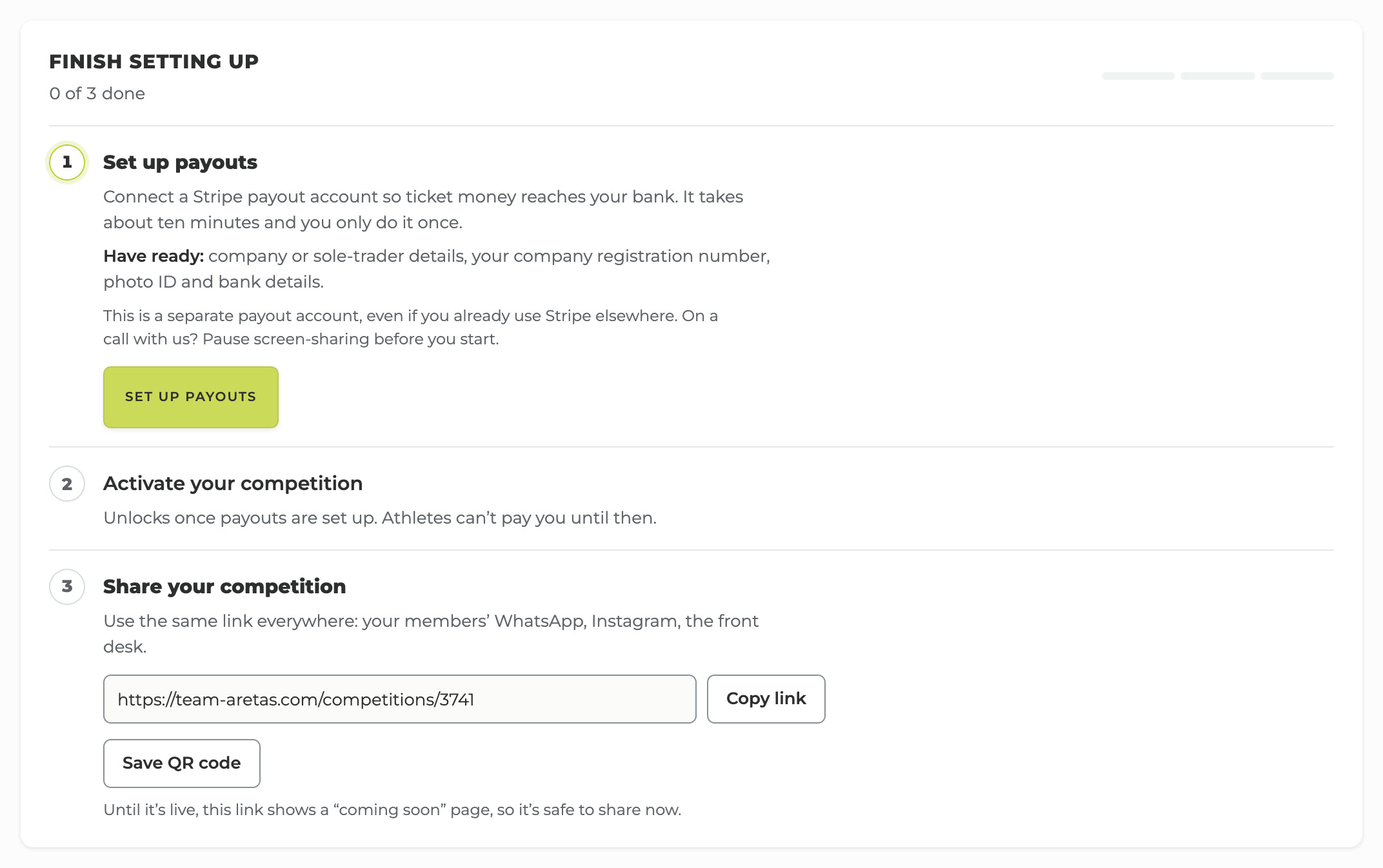
| Create the competition and set up your payout account | Organiser |
A competition is in draft until you activate it, so you can build it now and open entries later. Before it goes live, the dashboard lists what is left to do:
16 weeks out
Everything an athlete reads before paying has to be settled before entries open:
| Done | Task | Who |
|---|---|---|
| Set the price for each category, and the early bird price | Organiser | |
| Write the refund and withdrawal policy | Organiser | |
| Set a deadline for teams to change members | Organiser | |
| Write the waiver, and have it checked | Organiser | |
| Open entries and share the link everywhere at once | Organiser | |
| Start recruiting judges: 9 for the day, plus a second crew | Head judge | |
| Contact sponsors, with the date and the numbers you expect | Organiser |
12 weeks out
The workouts decide the kit, and the kit decides the floor:
| Done | Task | Who |
|---|---|---|
| Write the workouts and test each one on athletes from every category | Organiser and head judge | |
| Check every time cap still fits its slot (14, 16 and 12 minutes) | Organiser | |
| Write the movement standards for each workout | Head judge | |
| List the equipment from the workouts, and book what you do not own | Organiser | |
| Book first aid for the whole day | Organiser | |
| Recruit the rest of the staff: marshal, floor crew, score desk, check-in, MC | Organiser |
8 weeks out
Releasing the workouts one at a time gives athletes something to train for and something to share:
| Done | Task | Who |
|---|---|---|
| End the early bird on the date you promised | Organiser | |
| Release workout 1 with its standards, a video and a social media post | Organiser | |
| Confirm every judge by name and send them the standards | Head judge | |
| Confirm the kit hire and its delivery time | Organiser |
4 weeks out
By now the field is mostly fixed and the schedule can be built around it:
| Done | Task | Who |
|---|---|---|
| Release workouts 2 and 3, each with its standards, a video and a social media post | Organiser | |
| Pass the team change deadline, and chase every team still short of members | Organiser | |
| Draft the heats, one category per heat, easiest first | Organiser | |
| Draw the floor plan: warm-up, holding pen, lanes, score desk, spectators, first aid | Organiser | |
| Order your medals and prizes, or confirm the ones your sponsors are giving, and when they will arrive | Organiser |
2 weeks out
Athletes plan travel around their heat time, so publish it with time to spare:
| Done | Task | Who |
|---|---|---|
| Close entries | Organiser | |
| Publish the heats and tell every athlete their time | Organiser | |
| Write the run of show, minute by minute | Organiser | |
| Send the staff rota: who is where, and when | Organiser | |
| Prepare the judges' briefing from the movement standards | Head judge |
The week of the event
The last week is for checking, not deciding:
| Done | Task | Who |
|---|---|---|
| Email athletes: doors at 08:00, check-in, heat times, parking, what to bring | Organiser | |
| Check the kit against the list: 24 wall balls, 18 barbells, 8 boxes, the rig | Floor crew | |
| Print score sheets, or test every device judges will score on | Score desk | |
| Confirm first aid, the venue access time and the insurance certificate | Organiser | |
| Check the clock and the music | MC |
On the day
The day itself, from doors to the last heat:
| Time | Task | Who |
|---|---|---|
| 07:00 | Kit out, lanes marked, clock and score desk set up | Floor crew |
| 08:00 | Doors and check-in open; judges' briefing | Check-in and head judge |
| 08:30 | First heat | Everyone |
| 12:00 and 16:20 | 20-minute resets between workouts | Floor crew |
| 19:40 | Last heat finishes; check the final scores | Head judge |
| After the last heat | Awards, then pack down | Organiser |
The week after
The week after is when next year's entries are won or lost:
| Done | Task | Who |
|---|---|---|
| Publish the final results | Organiser | |
| Thank athletes, judges and staff, with the results and the photos | Organiser | |
| Send an athlete survey of 8 to 10 questions | Organiser | |
| Send each sponsor a short report with the numbers | Organiser | |
| Hold a debrief with the head judge and the staff | Organiser | |
| Set next year's date and open the early bird while people are still talking about it | Organiser |
Common mistakes
- Opening entries before the refund policy is written. The first athlete to ask for their money back sets your policy for you.
- Publishing heats the week before. Athletes have already booked travel around a guess, and the changes all arrive in the last week.
- Releasing all the workouts at once. Athletes have nothing to talk about for the next two months.
- No owner on a job. "Someone will print the score sheets" means nobody does.
- Leaving the debrief for a month. Nobody remembers what went wrong at 16:20 by then.
Run it on Team Aretas
Team Aretas keeps a competition in draft until you activate it, and the dashboard shows what is left before it goes live: payouts, activation and the link to share. Categories carry their own prices and caps, an early bird can be a discount code with a usage limit, and the team change deadline closes rosters for you. Workouts release on their dates, athletes see their heat time once you publish the heats, and check-in and scoring run on the day from the same place.