Functional fitness competition glossary
The words organisers, judges and athletes use about a functional fitness competition, in plain English. Send it to a first-time athlete, a new volunteer or a sponsor, and the briefing will make sense to them.
Where a number helps, it comes from the example every Team Aretas resource uses: 120 athletes, 8 lanes, one day.
The short answer
Three pairs of words cause most of the confusion:
- Heat and wave. A heat is one group doing one workout; a wave is one group starting a whole race together.
- Rx and scaled. Rx is the workout as written; scaled is a lighter, easier version of the same workout.
- Time cap and tiebreak. The time cap is when a workout stops; the tiebreak is a time recorded part-way through, used to split athletes who finish level.
The schedule
How the day is laid out, from the first heat to the last.
- Heat: one group of athletes doing one workout at the same time, one athlete or team to a lane. With 8 lanes, 120 athletes need 15 heats for each workout.
- Heats (schedule): a schedule where every athlete does every workout, one heat after another, then the next workout starts.
- Lane: one athlete's or team's space on the floor, with their own kit and their own judge.
- Wave: a group that starts a race together and stays on the course until they finish. A hybrid race of 120 athletes might run 15 waves of 8.
- Wave interval: the gap between one wave's start and the next. Ten minutes between 15 waves means the last wave starts 2 hours 20 minutes after the first.
- Pen time: when a wave has to be in the start pen, usually 10 to 15 minutes before it starts.
- Slot: the time one heat occupies the floor: the time cap plus the changeover. A 10-minute cap with a 4-minute changeover is a 14-minute slot.
- Changeover: the minutes between heats, for athletes to leave, the next heat to come on and the kit to be reset.
- Reset: a longer break between workouts, to change the floor over. Twenty minutes is common.
- Run of show: the minute-by-minute plan for the day, from doors opening to packing down.
Categories
How the field is split, so that athletes are ranked against the right people.
- Category: a group of athletes ranked against each other, for example Rx women or Masters men. Some competitions call them divisions.
- Rx: the workout as written, at the prescribed loads and standards.
- Scaled: a lighter, easier version of the same workout, so newer athletes can take part.
- Masters: older athletes, usually 35 and over, sometimes split further into 35 to 39, 40 to 44 and so on.
- Teens: athletes under 18, usually 14 to 17, on lighter loads and with a parent's or guardian's consent.
- Pairs or doubles: two athletes entered as one, sharing a lane and splitting the work.
- Team: three or more athletes entered as one. A team of four usually needs two lanes.
- Relay: a team where one athlete at a time is working and the others wait their turn.
Workouts
What athletes are asked to do, and the rules that decide whether it counts.
- For time: do the work as fast as you can. The fastest time wins.
- AMRAP: as many rounds as possible in a set time. The highest count wins.
- EMOM: every minute on the minute. Start a set of work at the top of each minute and rest for whatever is left of it.
- Chipper: a long list of movements done once each, in order, "chipping away" at the total. Fifty wall balls, then 30 box jump overs, then 20 power cleans is a chipper.
- Max lift: the heaviest weight lifted for one rep, often within a time window such as 8 minutes.
- Time cap: the point at which a workout stops, finished or not. An athlete still working at the cap is capped, and is ranked by the reps they completed.
- Tiebreak: a time recorded at a set point in a workout, used to split athletes with the same result. "Your time at rep 50" is a tiebreak.
- Movement standards: the written rules for each movement: where it starts, where it finishes and what does not count.
- No-rep: a rep the judge does not count because it did not meet the standard. The athlete has to do it again.
- Station: in a race, one block of work done between runs, such as a 1,000 m row.
- Run loop: the measured course athletes run in a race, usually 400 m or 500 m a lap.
- Transition zone: where the run loop meets the stations, with one way in and one way out.
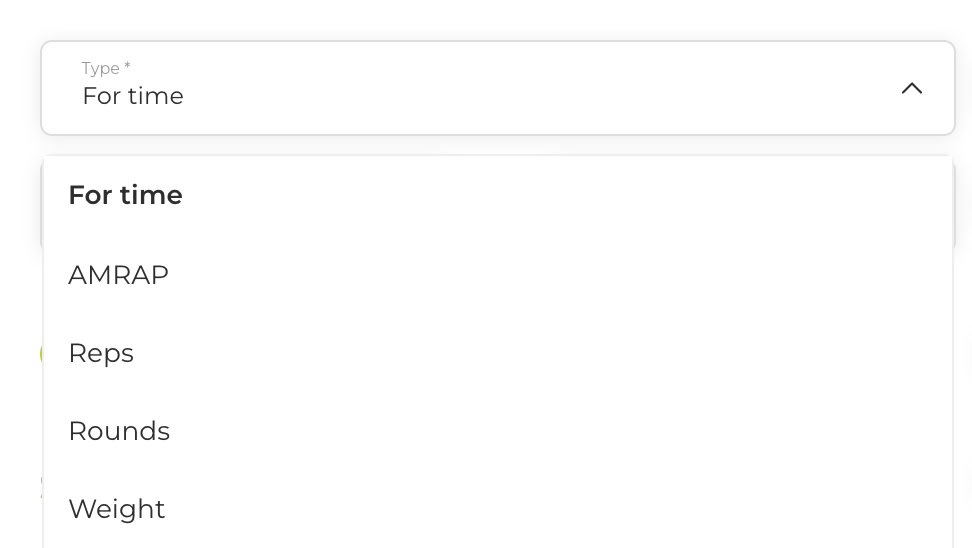
The first five workout types, as the Team Aretas workout editor lists them:
Scoring
How results become places, and places become a winner.
- Rank sum: your place in each workout is your score for it, and the lowest total wins. Places of 12th, 14th and 15th make 41.
- Points per place: each place earns points, and the highest total wins. In a field of 120, first earns 120 points and last earns 1.
- Tie: two athletes with the same result share the place, shown as 3T, and the next athlete takes fifth.
- Overall tiebreak: the rule that splits athletes on the same total, usually whoever placed higher in the last workout.
- Leaderboard: the ranking of every athlete in a category, workout by workout and overall.
- Combined leaderboard: in a league, one ranking of every athlete across all the gyms that ran the same workouts.
People
Who does what on the floor.
- Lane judge: counts the reps and calls the no-reps for one lane.
- Head judge: runs the judging, briefs the lane judges and rules on disputes.
- Marshal: calls each heat to the floor on time.
- Score desk: takes signed scores from the judges and enters them.
- Floor crew: changes the loads and resets the kit between heats.
Run it on Team Aretas
Team Aretas uses these words the way this page does. Workouts are set as for time, AMRAP, reps, rounds, weight, distance, calories, score, position or versus, each with its own time cap, tiebreak and movement standards. Categories are built from Rx, scaled, masters and teens, individuals, pairs and teams. Heats and waves are laid out with their times, and the leaderboard ranks every workout as scores come in.