Fitness competition scoring explained
Most fitness competitions rank athletes on each workout and add those places up. That part is simple. Close finishes are decided by the smaller rules around it: how a place becomes points, how a tie breaks, what a time-capped athlete scores and what a missed workout counts as. Each of those belongs in your rulebook before the first heat, not at the podium.
This guide works through every choice with the worked example every Team Aretas resource uses: 120 athletes, 8 lanes, one day.
The short answer
- Use rank sum unless you have a reason not to. Your place in each workout is your score for it, and the lowest total wins. It is quick to explain and hard to argue with.
- Write down the tiebreak, the time-cap rule and what a missed workout scores before entries open, so nobody learns the rules from their result.
- Rx and scaled athletes can share a board, as long as everyone knows that every Rx score ranks above every scaled one.
The worked example
The same 120 athletes, in one category, doing three workouts with the time caps from the scheduling guide:
| Workout | Format | Time cap |
|---|---|---|
| Workout 1 | 100 reps for time | 10 min |
| Workout 2 | As many reps as possible | 12 min |
| Workout 3 | Heaviest lift | 8 min |
Every example below uses three athletes from that field: Asha, Ben and Cara.
Places into points
Rank sum
Your place in a workout is your points for it, and the lowest total wins. Here are the three athletes' places across the day:
| Athlete | Workout 1 | Workout 2 | Workout 3 | Total |
|---|---|---|---|---|
| Asha | 1st | 2nd | 40th | 43 |
| Ben | 12th | 14th | 15th | 41 |
| Cara | 5th | 30th | 8th | 43 |
Ben never wins a workout and still finishes ahead of both. That is rank sum doing what it is designed to do: it rewards the athlete who is good at everything over the one who is brilliant at two things, because one bad result costs more than two wins earn. Asha and Cara tie on 43, which the next section settles.
Points per place
Each place earns points, and the highest total wins: first of 120 earns 120 points, second earns 119, and so on down to 1 point for last place. This is rank sum turned upside down, and it gives exactly the same order: Asha scores 320, Ben 322 and Cara 320. Choose it if your athletes would rather see their total go up than down.
A missed workout
In rank sum, an athlete with no score for a workout takes last place for it. If Ben misses workout 3, it counts as 120th, and his total goes from 41 to 146. In points per place he scores nothing for it, which comes to the same thing.
Two rules follow from that. A missed workout must never count as zero in rank sum, where zero would beat first place. And a workout nobody has scored yet should count for nobody, so publishing workout 3 before its first heat does not move anyone on the board.
Breaking ties
Inside a workout
A tiebreak is a time recorded at a set point in the workout: in workout 1, the moment an athlete finishes rep 50. Two athletes with the same result are split by who reached that point first. Without a tiebreak they share the place, shown as 3T, and the next athlete takes the place after the tie: fifth, not fourth.
On the overall board
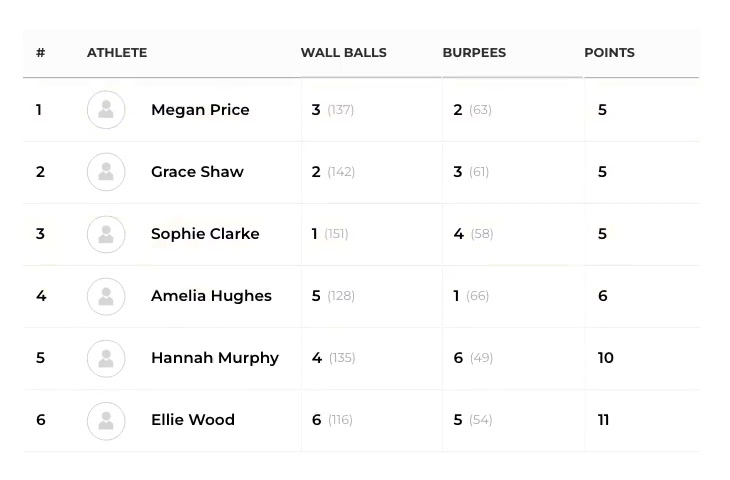
When totals tie, look at the last workout: the athlete who placed higher in it goes ahead, and if they tied there too, look at the workout before. Asha and Cara are both on 43. In workout 3, Cara was 8th and Asha 40th, so Cara finishes ahead.
The last workout is the usual choice because it is the one everyone has just watched, and it rewards finishing strong. Other rules exist, such as the most workout wins or the best single place. Pick one and print it. The leaderboard below shows the rule at work, with three athletes on 5 points:
Time caps
In a workout for time, everyone who finishes is ranked by time. Anyone who is still working at the cap is ranked by the reps they completed, below every finisher, however close they came. Here is how part of workout 1 places, with a 10-minute cap on 100 reps:
| Athlete | Result | Tiebreak (rep 50) | Place |
|---|---|---|---|
| Dev | 8:41 | 1st | |
| Ella | 9:58 | 2nd | |
| Finn | Capped at 96 reps | 6:10 | 3rd |
| Gina | Capped at 96 reps | 6:42 | 4th |
| Hal | Capped at 90 reps | 5th |
Finn and Gina both did 96 reps, so the tiebreak decides it. A judge who only writes "capped" turns the bottom of every heat into one shared place, so the score sheet needs a rep count for every capped athlete.
Versus and multi-part workouts
Versus
Two athletes or teams race each other, and the result is a win or a loss rather than a time. Every winner shares first place on that workout and every loser shares last. In a final of 8 teams, the 4 winners score 1 each and the 4 losers score 8 each in rank sum. That 7-point swing on a single race is bigger than most workouts produce, which is why a versus workout usually decides a final rather than sitting in the middle of a day.
Multi-part workouts
A workout in parts can be scored two ways:
- As separate workouts, Part A and Part B. Each part earns a full set of places, so the event counts double. Do this deliberately.
- As one score that adds the parts up, such as the total of three lifts or the combined time of three runs. Every athlete needs a result for every part before a total exists; a missing part is a missing score.
Rx and scaled on one board
When a workout allows scaling, every Rx result ranks above every scaled result, and scaled athletes are ranked among themselves after the last Rx athlete. With 100 Rx and 20 scaled athletes in the field, the best scaled athlete places 101st on that workout.
That is the point of Rx: the standard is the harder test. But it surprises athletes who expected a separate board, so say so with the workouts, or run scaled as its own category if you want a separate podium.
Holding scores back
You do not have to show every score the moment it is entered. There are three common reasons to wait: announcing a final on stage, checking video submissions before they count, and keeping the last workout's order a surprise until the awards.
- Release workouts on a date. Until then, athletes see the slot and its release date but not the workout.
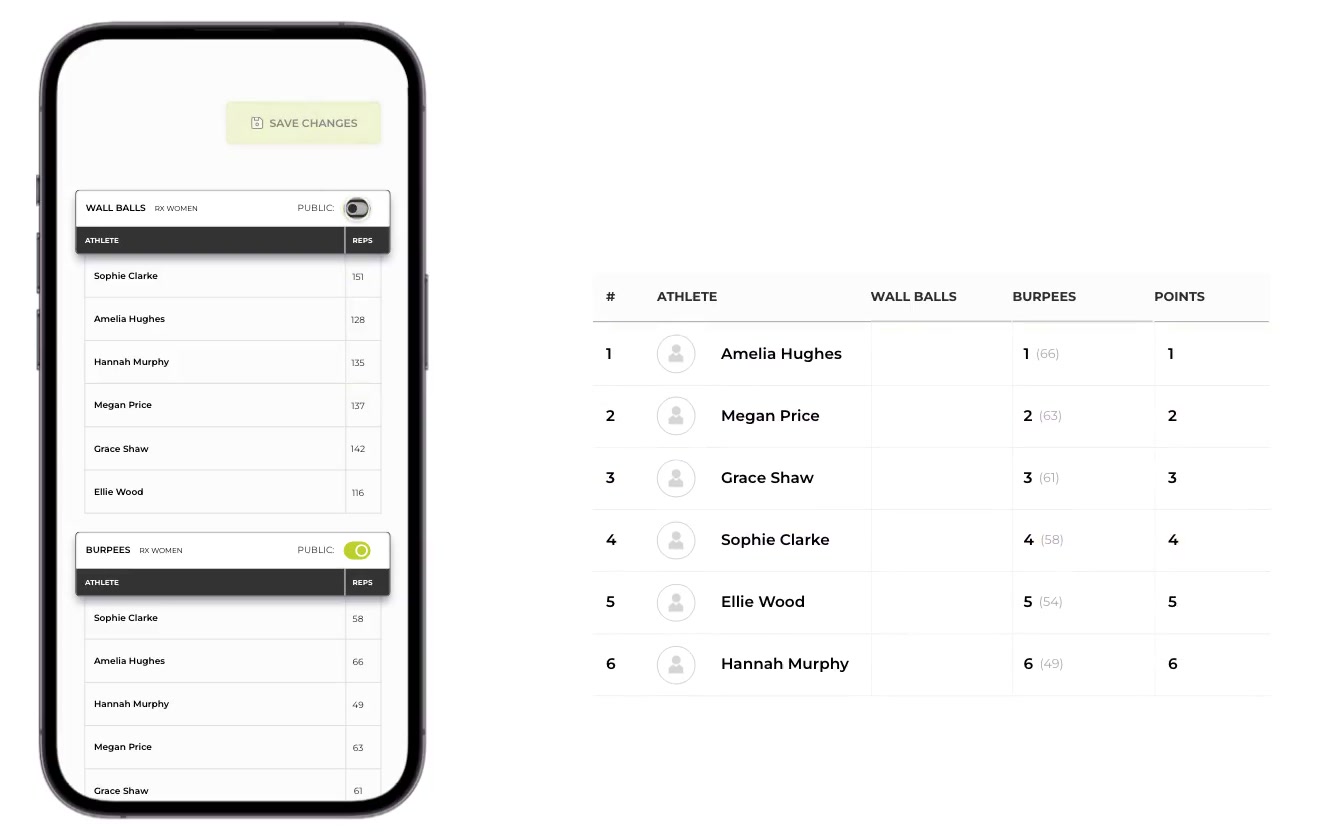
- Hide one workout's scores. Judges keep entering them, but the column stays blank on the leaderboard and does not count towards anyone's total until you switch it back on.
- Keep the real board to yourself. As the organiser, you still see every score while athletes wait.
Here the Wall Balls scores are hidden, so the leaderboard ranks on Burpees alone:
Common mistakes
- No tiebreak written down. Two athletes on 43 and no rule turns a podium into an argument. Choose the rule before entries open.
- A missed workout counted as zero. In rank sum zero beats first place; a missed workout has to count as last.
- "Capped" with no rep count. It puts everyone at the cap on one shared place and makes the heat impossible to rank.
- Letting athletes carry on past the time cap. When the cap hits, the workout is over: the judge records the reps done by then, and that is the score. An athlete allowed to keep going and then given a finish time has a result the workout does not allow, and it ranks them above athletes who stopped at the cap as they should.
- Changing the scoring after the first workout. Even a fair change looks like moving the goalposts once scores are public.
Run it on Team Aretas
Team Aretas scores by rank sum or by points per place, whichever you choose in your competition settings. It ranks each workout as soon as a score is saved, ranks capped athletes by reps below every finisher, splits equal results on a tiebreak time and breaks overall ties on the last workout. It also handles Rx and scaled results, versus races and workouts in parts. You can release workouts on a date, hide a workout's scores until you are ready, and see the full board yourself the whole time.