Running a functional fitness throwdown
A functional fitness throwdown is three or four short, hard workouts in one day, run in heats across a row of lanes, with athletes split into categories by ability, age and sex. This is the classic CrossFit-style competition. This playbook covers everything you set before entries open: the categories, the workouts and their standards, the heat order, the floor, the kit and the people.
Everything is worked through on the example every Team Aretas resource uses: 120 athletes, 8 lanes, one day.
The short answer
- Set every category's cap to a multiple of your lane count. With 8 lanes, a category of 6 costs a whole heat on every workout, which is 42 minutes on this day.
- Publish a movement standards document with each workout, and brief the judges from the same document, so athletes and judges are held to one set of words.
- Run one category per heat, easiest first, and stage the next category's kit before its first heat.
The worked example
The day uses the three workouts and slots from the scheduling guide, scored by rank sum as in the scoring guide:
| Workout | Format | Time cap | Slot |
|---|---|---|---|
| Workout 1 | For time: 50 wall balls, 30 box jump overs, 20 power cleans | 10 min | 14 min |
| Workout 2 | As many reps as possible: 5 pull-ups, 10 push-ups, 15 air squats | 12 min | 16 min |
| Workout 3 | Heaviest clean and jerk | 8 min | 12 min |
A slot is the time cap plus a 4-minute changeover for the next heat to set up. Each workout runs 15 heats, with a 20-minute reset between workouts, so the last heat finishes at 19:40.
Categories
Most throwdowns split by ability (Rx and scaled), then by sex, then by age. Here is a field of 120 that fills every heat exactly:
| Category | Athletes | Heats of 8 |
|---|---|---|
| Scaled women | 24 | 3 |
| Scaled men | 24 | 3 |
| Masters women (35+) | 8 | 1 |
| Masters men (35+) | 16 | 2 |
| Rx women | 24 | 3 |
| Rx men | 24 | 3 |
| Total | 120 | 15 |
Rx means the workout as written, at the prescribed loads and standards. Scaled uses lighter loads and easier versions of the hardest movements, so newer athletes can finish the same workouts. Keep them as separate categories with their own podiums; the scoring guide covers putting both on one board if you have a reason to.
Masters and teens
- Masters usually start at 35. One masters category per sex is plenty for a field this size; you can split the results into 35 to 39, 40 to 44 and 45 and over on the leaderboard without running extra heats.
- Teens are usually 14 to 17, on lighter loads than scaled. You need written consent from a parent or guardian, and check that your insurance covers under-18s before you open the category. Everyone working with them needs to be checked as safe to work with children: a DBS check in England and Wales, PVG in Scotland, AccessNI in Northern Ireland. This adds a lot of work, so decide early whether a teens category is worth it.
Pairs and teams of four
A pair usually works in one lane, taking turns or splitting the reps. A team of four usually needs a much wider lane; we recommend the space needed for two lanes. That changes the heat count, not the number of people on the floor:
| Change | Lanes per workout | Heats per workout | Last heat finishes |
|---|---|---|---|
| As planned: 120 individuals | 120 | 15 | 19:40 |
| Scaled as 24 pairs | 96 | 12 | 17:34 |
| Rx as 12 teams of four, two lanes each | 96 | 12 | 17:34 |
| Rx as 12 teams of four, a lane each | 120 | 15 | 19:40 |
Pairs, and teams of four on two lanes, both put two athletes in each lane, so either change finishes the day over two hours earlier. A team of four that needs a lane each saves nothing. If you want a mixed team category, say in the rules whether it must be two men and two women or any mix.
Caps in multiples of 8
A category that does not fill its last heat still costs a whole slot on every workout. Add a teens category of 6 and every workout gains a heat: 14 + 16 + 12 = 42 minutes, so the last heat finishes at 20:22 instead of 19:40. Cap it at 8 and it costs the same, with two more places to sell.
Workouts and standards
Writing the workouts
Each workout needs a format, a time cap, a tiebreak and a scaled version, all published before the day:
| Workout | Tiebreak | Rx | Scaled |
|---|---|---|---|
| Workout 1 | Time at the end of the wall balls (rep 50) | 9 kg / 6 kg ball, 24" / 20" box, 60 kg / 40 kg clean | 6 kg / 4 kg ball, step-overs allowed, 40 kg / 25 kg clean |
| Workout 2 | Time at the end of the last full round | As written | Jumping pull-ups, push-ups with hands on a box |
| Workout 3 | None: the heaviest lift wins | Clean and jerk | Power clean and push press |
Put the tiebreak at the end of a movement, not in the middle of one, so a judge can see it happen. Every athlete who hits the cap needs a rep count, or the bottom of every heat becomes one shared place.
The movement standards document
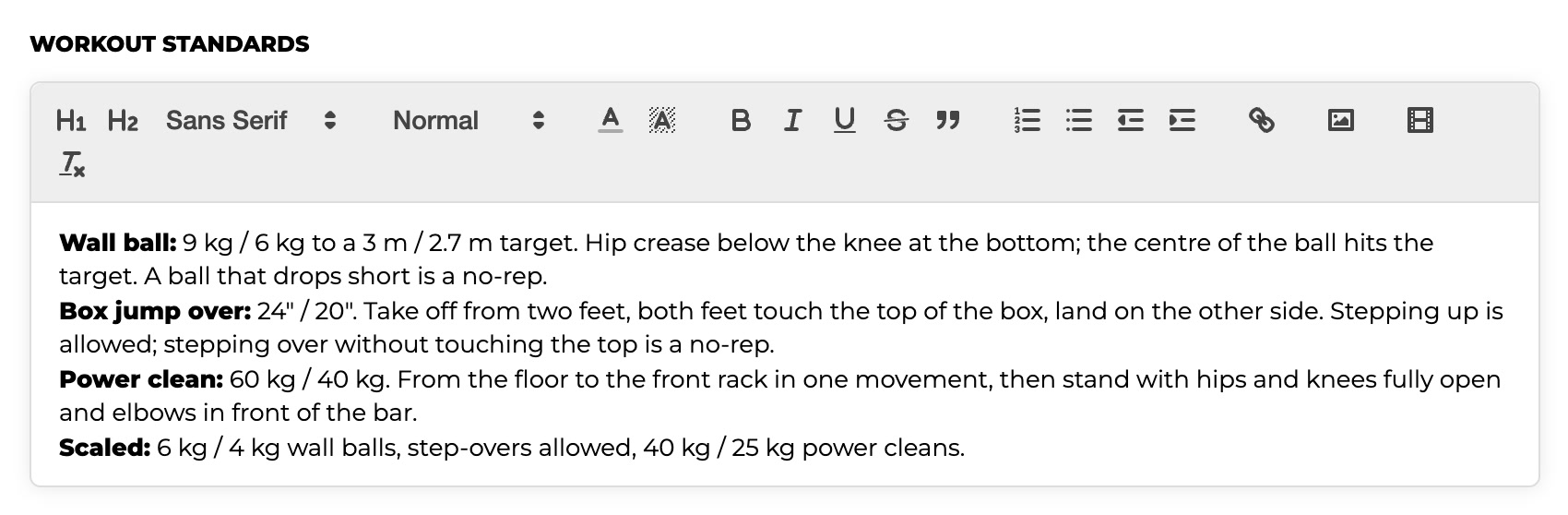
For every movement, write down where it starts, where it finishes, the load and what counts as a no-rep. Add a short video of each movement if you can, because a video settles arguments that a sentence starts. Publish it with the workout, and use the same document word for word in the judges' briefing. Here are workout 1's standards as they are written in the workout editor:
Heats and lanes
Run one category per heat so athletes race the people they are ranked against, and run the categories easiest first, so the Rx heats close each workout:
| Heats | Category | First heat starts (workout 1) |
|---|---|---|
| 1 to 3 | Scaled women | 08:30 |
| 4 to 6 | Scaled men | 09:12 |
| 7 | Masters women | 09:54 |
| 8 to 9 | Masters men | 10:08 |
| 10 to 12 | Rx women | 10:36 |
| 13 to 15 | Rx men | 11:18 |
Each workout changes load five times, at every switch between categories. The 4-minute changeover only covers that if the next category's wall balls, plates and box heights are staged before its first heat starts.
The floor
Lay the space out in the order an athlete moves through it:
| Zone | What happens there |
|---|---|
| Warm-up | The next two heats warm up, with their own kit |
| Holding pen | The heat after this one checks in with the marshal |
| Competition floor | 8 numbered lanes, one judge in each, a clock every lane can see |
| Kit staging | The next category's balls, plates and boxes, behind the lanes |
| Score desk | Judges hand in signed scores; the head judge sits here |
| Spectators | Behind a barrier, with a view of the clock |
| First aid | Next to the floor exit |
Allow about 3 metres of width per lane for barbell work, so a judge can stand clear of a dropped bar.
Equipment
For 8 lanes and the three workouts above:
| Item | Quantity | Used in |
|---|---|---|
| Wall balls: 9 kg, 6 kg and 4 kg | 8 of each | Workout 1 |
| Wall-ball targets, marked at 3 m and 2.7 m | 8 | Workout 1 |
| Boxes, 24" and 20" | 8 | Workouts 1 and 2 |
| Barbells, 20 kg and 15 kg | 8 of each, plus 2 spares | Workouts 1 and 3 |
| Bumper plates and collars | Enough to load 8 bars to the heaviest lift you expect | Workouts 1 and 3 |
| Pull-up rig | 8 stations | Workout 2 |
| Clock and timing | 1 per floor, plus a backup | Every workout |
Staffing
On the floor for every heat:
| Role | People | Job |
|---|---|---|
| Lane judges | 8 | Count reps and call no-reps, one per lane |
| Head judge | 1 | Rules on disputes and signs off scores |
| Heat marshal | 1 | Calls the next heat to the holding pen |
| Floor crew | 2 | Change loads and kit in each changeover |
| Score desk | 1 | Enters each score as it is signed |
| Check-in | 2 | From doors at 08:00 until the first heats are through |
| MC and music | 1 | Keeps the day moving and the crowd with it |
| First aid | 1 | All day |
That is 17 people. One crew of 9 judges can cover the day, but a second crew taking over at the resets keeps the last Rx heat judged like the first.
Common mistakes
- Category caps that ignore the lanes. A category of 6 on 8 lanes adds a heat with 2 empty lanes to every workout: 42 minutes on this day.
- Standards published late, or written vaguely. Athletes train to the standard they read, and judges call the one they were briefed on. If the two differ, the scores are argued on the day.
- One set of loads on the floor. Without the next category's kit staged, every switch between categories overruns its changeover.
- No holding pen. A heat that walks on a minute late costs a minute, and 45 late heats cost 45 minutes.
- Masters and teens on Rx loads. It thins the categories you most want to grow.
Run it on Team Aretas
Team Aretas builds every category here, from scaled pairs to masters, each with its own price and capacity, and age filters split a leaderboard without extra heats. Each workout carries its time cap, tiebreak, scaled option, standards and video, and can stay hidden until its release date.