Running a hybrid race or HYROX sim
A hybrid race is one long effort: a run, then a workout station, then another run, repeated until the finish line. Athletes set off in waves, the result is a time, and the station that takes longest decides how close together the waves can go. This playbook covers the course, the waves, the kit and the people.
Everything is worked through on the example every Team Aretas resource uses: 120 athletes, 8 lanes, one day.
The short answer
- Start a new wave no sooner than the slowest athlete can clear the slowest station. For this race that is every 15 minutes, which finishes the day at 12:15.
- Count laps with a system, not memory. The day holds about 1,250 lap counts.
- Give each division its own waves, and keep kit for every division's loads at every station, because waves of different divisions are on the course at the same time.
A hybrid race or a HYROX sim
The two look the same on the day. The difference is who sets the course:
- A HYROX sim follows the HYROX race exactly: the same runs, the same eight stations in the same order, at the same loads. Athletes enter one to compare themselves with an official race, so nothing about the course changes.
- A hybrid race is your own event. It can start from the same course, but you decide the runs, the stations, their order and the loads, so you can put your own spin on it: shorter runs for a beginners' race, a station that shows off your gym, or a sandbag carry where you have no sleds.
HYROX is a registered trademark of HYROX World GmbH. Either way, an event you organise is independent and not an official HYROX race, so say so in your listing, and only call it a HYROX sim if it follows the HYROX course exactly. This playbook works through a hybrid race; running a HYROX sim will have a guide of its own.
The worked example
This hybrid race starts from the same course as a HYROX race: eight 1 km runs, each followed by a station. A station is one block of work, done once, before the next run. In order:
- Ski erg, 1,000 m
- Sled push, 50 m
- Sled pull, 50 m
- Burpee broad jumps, 80 m
- Row, 1,000 m
- Farmers carry, 200 m
- Sandbag lunges, 100 m
- Wall balls, 100 reps
Assume the slowest finisher takes up to 90 minutes from start to finish, as in the scheduling guide. Shorten the runs, change the stations or set your own loads and the planning below works the same way.
Categories
Most races offer solo, doubles and relay, each split into men's, women's and mixed, and some add a heavier Pro division for solo and doubles. The format decides how many athletes share one starting place:
- Solo: one athlete does everything.
- Doubles: two athletes run every run together and split the work at each station, so a pair takes one starting place.
- Relay: four athletes take two runs and two stations each, one of them on the course at a time, so a team takes one starting place.
Here is the field of 120, with 8 starting places in each wave:
| Category | Athletes | Entries | Waves |
|---|---|---|---|
| Solo | 48 | 48 | 6 |
| Doubles | 48 | 24 pairs | 3 |
| Relay | 24 | 6 teams | 1 |
| Total | 120 | 78 | 10 |
The same 120 athletes racing solo would need 15 waves. Doubles and relay put more people through each starting place, so the day is 5 waves shorter.
Waves
A wave is a group that starts together, and the wave interval is the gap between one wave's start and the next. Every wave here is held for one category and starts 15 minutes after the one before:
| Waves | Category | First start | Last start |
|---|---|---|---|
| 1 to 6 | Solo | 08:30 | 09:45 |
| 7 to 9 | Doubles | 10:00 | 10:30 |
| 10 | Relay | 10:45 | 10:45 |
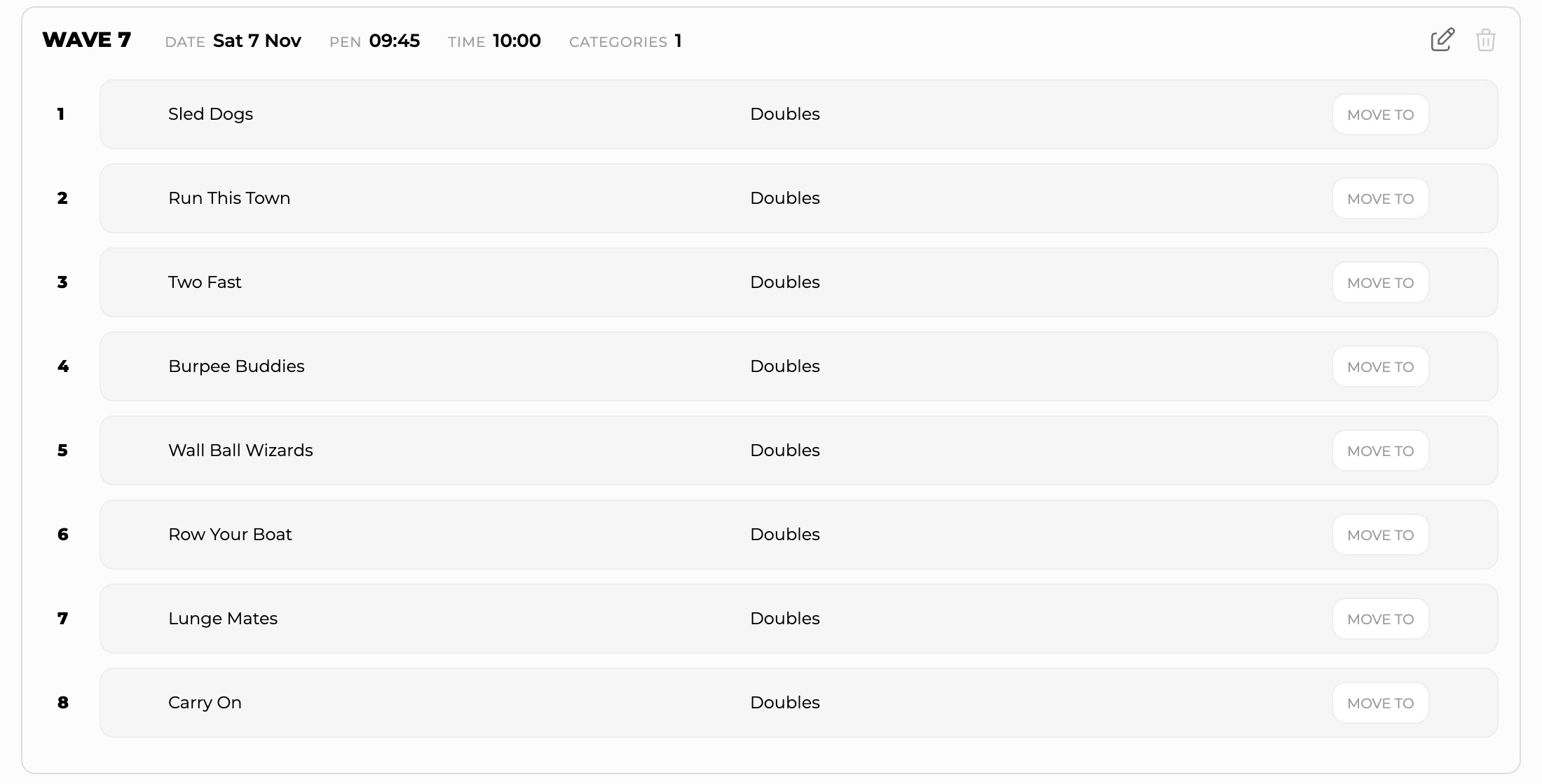
The last wave starts at 10:45 and its slowest team finishes by 12:15. Call each wave to the start pen 15 minutes before it goes, so it is checked and ready while the wave in front is still leaving. Here is wave 7, the first doubles wave, with its pen time and start time:
Choosing the interval
A wave arrives at the first station almost together and spreads out as the race goes on. The interval has to be at least as long as the slowest athlete in a wave takes on the slowest station, or the next wave catches them and queues for kit. If the slowest wall-ball set takes 10 minutes, 10 minutes is the floor and 15 gives a margin for the day not going to plan:
| Wave interval | Last wave starts | Last athlete finishes | Waves on the course at once |
|---|---|---|---|
| 10 min | 10:00 | 11:30 | Up to 9 |
| 15 min | 10:45 | 12:15 | Up to 6 |
| 20 min | 11:30 | 13:00 | Up to 5 |
The last column is the race time divided by the interval, rounded up. At 15 minutes, up to 6 waves and 48 entries are racing at once, and that is the number every station and the run loop have to cope with.
Letting athletes choose
Let athletes book their own wave, inside their category's waves. Friends can start together, and people travelling far can take a later start. Cap every wave at its 8 starting places so no station is ever asked to hold a ninth.
The run loop
Few venues have 1 km of space, so most races run laps of a shorter loop. A 400 m or 500 m loop is most common. With a 500 m loop, each run is 2 laps and the race is 16 laps. Across 78 entries that is 1,248 laps to count in one day, so give it a system:
- Measure the loop with a measuring wheel, along the line athletes will actually run, and mark the turns with cones so nobody cuts a corner. GPS is not accurate enough indoors or on a short loop.
- Count laps with something the athlete carries. A band or token collected at the end of each lap, and handed in at the station, means a judge checks a number rather than remembers one.
- Keep the run loop one way. Athletes on their first lap and their sixteenth share the same path, and two-way running is how collisions happen.
The transition zone
The transition zone is where the run loop meets the stations. Athletes leave the loop, do their station and rejoin the loop through it.
- Mark one entry and one exit, so nobody shortens a run by leaving the loop early.
- Decide whether time in the transition zone counts as running. Write it in the rules either way.
- Put the lap check at the entry, so an athlete with too few laps is sent back before the station, not disqualified after the finish.
Equipment
One wave arrives at the first station together, so every station needs enough for a full wave:
| Station | Quantity |
|---|---|
| Ski ergs | 8 |
| Sleds, with marked push and pull lanes | 8 |
| Burpee broad jump lane | 80 m of clear floor |
| Rowers | 8 |
| Farmers carry handles or kettlebells | 8 pairs |
| Sandbags | 8 |
| Wall balls and targets | 8 |
| Start clock and finish timing | 1 each, plus a backup |
Loads usually differ between men and women and between Open and Pro. Waves of different divisions are on the course at the same time, so every station needs kit at each load in use, clearly marked, rather than one set that is changed over.
Staffing
| Role | People | Job |
|---|---|---|
| Station judges | 15 | 1 each on the ergs and farmers carry, 2 each on sleds, burpee broad jumps and lunges, 4 on wall balls |
| Lap counters | 3 | 2 on the run loop and 1 at the transition zone entry |
| Start and finish | 2 | Start each wave and record each finish |
| Head judge | 1 | Rules on disputes and signs off results |
| Check-in and start pen | 2 | Check names and call each wave to the pen |
| Kit crew | 2 | Reset sleds and kit as waves pass |
| MC and first aid | 2 | One of each, all day |
That is 27 people, for a day that is over by lunchtime.
Results
Every athlete in a wave starts at the wave's start time, so the result is the finish time minus the start time, to the second. Rank each category on its own, and record a split at each station if you can: it settles disputes about a missed lap, and athletes love comparing them.
Common mistakes
- A wave interval shorter than the slowest station. The next wave queues for kit and every finish time stops meaning anything.
- Counting laps from memory. With 48 entries on the course, a judge cannot track who has run one lap of a run and who has run two.
- One set of loads at each station. Divisions overlap on the course, so somebody waits while a sled is changed.
- Calling the event an official race. A hybrid race or HYROX sim you organise is an independent event, and the listing has to say so.
- A loop measured on a map. Measure it with a wheel on the line athletes run, or every result is a few hundred metres out.
Run it on Team Aretas
Team Aretas sells solo, doubles and relay as categories with their own prices and capacities, and lets athletes book a start wave that has space, held for their category. Each wave carries its own pen time and start time. Judges enter start and finish times and the elapsed time is worked out for them, then each category's leaderboard is published when you are ready. Team Aretas is also adding HYROX sim as a format of its own: the course is set for you and cannot be changed, athletes will place on a global leaderboard, and sims will be listed in their own highlighted section.