Running a league across several gyms
A league runs the same competition at several gyms and ranks every athlete on their gym's leaderboard and on a combined leaderboard, as if they had all been on the same floor. Each gym runs its own day; the league owns the workouts, the standards and the final result.
Everything is worked through on the example every Team Aretas resource uses: 120 athletes, 8 lanes, one day, this time spread across five gyms.
The short answer
- Set the workouts, standards and loads once, for every venue. A 9 kg ball in one gym and a 10 kg ball in another are two different workouts.
- Judge to one briefing and check the top scores on video before the combined results are final.
- Run every venue at the same time, or hide each workout's scores until the last venue has done it.
The worked example
The same 120 athletes and the same three workouts as the throwdown playbook, spread across five gyms with 8 lanes each:
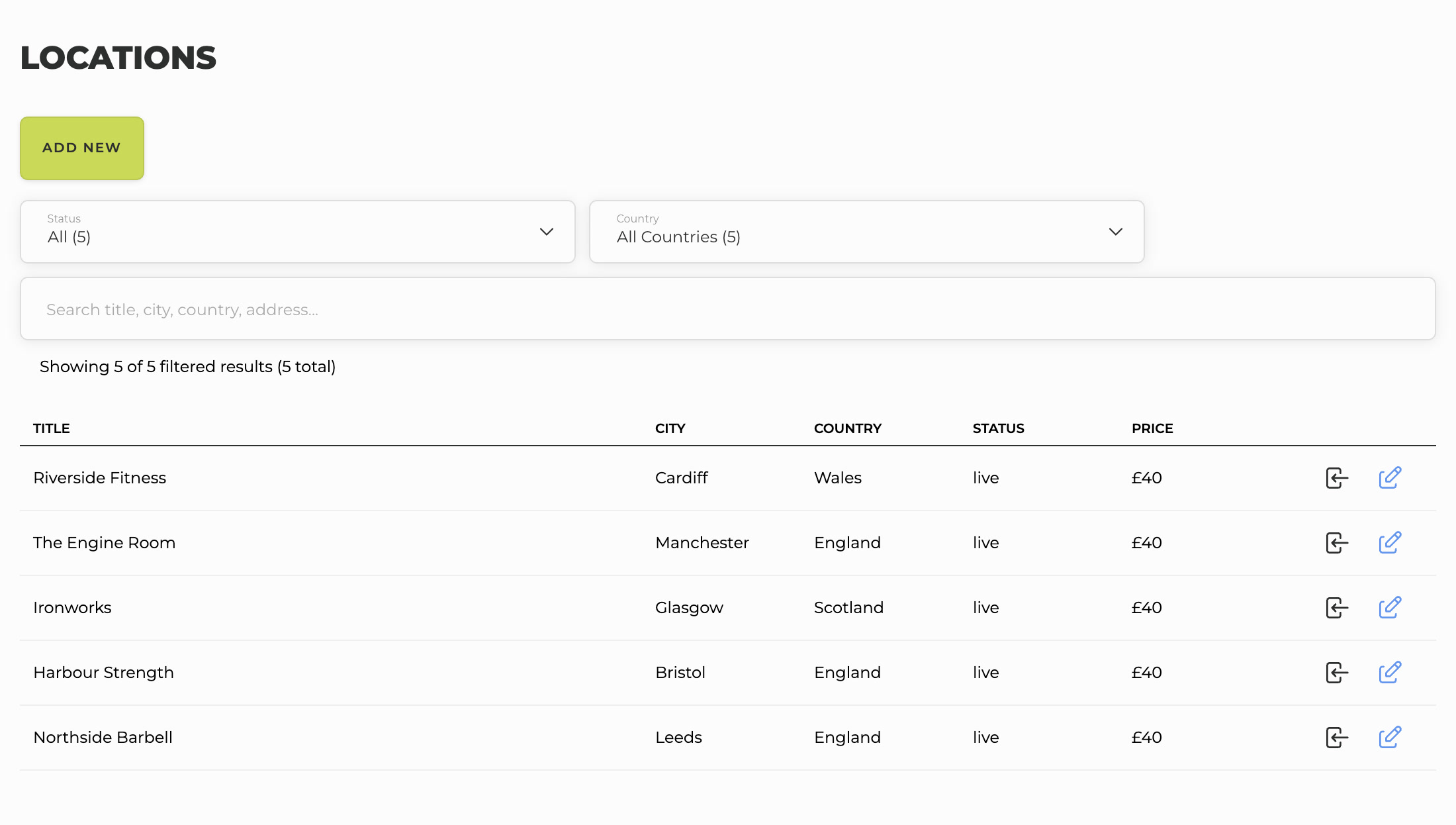
| Venue | City | Places | Heats per workout |
|---|---|---|---|
| Northside Barbell | Leeds | 24 | 3 |
| Harbour Strength | Bristol | 24 | 3 |
| Ironworks | Glasgow | 24 | 3 |
| The Engine Room | Manchester | 24 | 3 |
| Riverside Fitness | Cardiff | 24 | 3 |
| Total | 5 cities | 120 | 15 |
Each venue holds three categories of 8, one heat each: Rx men, Rx women and Scaled. Across the league that is 40 athletes in each category on the combined leaderboard.
How the day runs at each venue
With 3 heats per workout instead of 15, each venue's day is a morning:
| Workout | Slot | Heats | Runs |
|---|---|---|---|
| Workout 1 | 14 min | 3 | 08:30 to 09:12 |
| Workout 2 | 16 min | 3 | 09:32 to 10:20 |
| Workout 3 | 12 min | 3 | 10:40 to 11:16 |
The same 120 athletes on one floor finish at 19:40. Five floors finish before lunch, and each gym fills its morning with members and their friends rather than asking them to travel.
Setting up the league
The league is one competition that holds the workouts and the combined leaderboard, and each venue is a competition of its own under it, with its own entries, price, heats and scores:
What the league decides
- The workouts, time caps and tiebreaks, written once and used by every venue.
- The movement standards and loads, down to box heights (24" and 20") and ball weights.
- The categories, with the same names and rules at every venue, so each result lands on the right combined board.
- The scoring: rank sum across the whole league, with a missed workout counted as last place.
- The price: one price everywhere, so no venue undercuts another.
What each venue decides
- Its heat times, inside the league's date.
- Its own staff: lane judges, a head judge, a marshal and someone on the score desk.
- Its own floor, as long as every lane has the kit on the league's list.
Judging the same everywhere
Five head judges and 40 lane judges have never met, and one soft gym makes every other gym's athletes look slow. Three habits keep them together:
- One briefing for everyone. Run it on a video call the week before, from the movement standards, with a video of every movement. Every head judge then briefs their own lane judges from the same document.
- Film every heat. One phone on a tripod per heat, filming the whole floor, costs nothing and settles most disputes.
- Check the top before it is final. Before the combined results are published, the league head judge watches the video for the top 3 in every category at every venue. With three categories at five venues that is 45 performances, not 120.
Stopping results leaking
If Leeds runs workout 1 at 08:30 on Saturday and Cardiff runs it on Sunday, Cardiff's athletes can see the score they need to beat. Two ways round it:
- Run every venue at the same time. The example above has all five gyms starting at 08:30 on the same day, so nobody knows anything the others do not.
- Hide each workout's scores until the last venue has run it. Judges still enter them as they go, and the column appears on the leaderboard once you switch it back on.
Equipment
Every venue needs the kit for 8 lanes, and it has to be the same kit. Send each gym the list and ask for a photo of it set out the day before:
| Item | Each venue | League total |
|---|---|---|
| Wall balls: 9 kg, 6 kg and 4 kg | 8 of each | 120 |
| Boxes, 24" and 20" | 8 | 40 |
| Barbells, 20 kg and 15 kg | 8 of each, plus 2 spares | 90 |
| Pull-up rig | 8 stations | 40 stations |
Rowers and ski ergs differ between models, so if a workout uses them, name the model and the damper setting in the standards.
Staffing
Each venue runs a small version of the throwdown's crew:
| Role | Each venue | League total |
|---|---|---|
| Lane judges | 8 | 40 |
| Head judge | 1 | 5 |
| Marshal, floor crew, score desk, check-in | 4 | 20 |
| First aid | 1 | 5 |
| League organiser and league head judge | 2 |
That is 72 people across the league, and only 2 of them work for the league itself.
A season of rounds
A league can also run over time instead of across venues: one round a month, each with its own workout, and points that add up across the season. Run it as one competition, with each round's workout released on its date and scores entered at the end of each round. Two rules matter more than they do on a single day:
- Decide what a missed round scores before the season starts. In rank sum it counts as last place, so one missed round costs an athlete far more than one bad result.
- Publish the standings after every round, not just at the end, because a season people can follow is a season people finish.
Common mistakes
- Letting a venue swap the kit. A different ball weight or box height changes the workout, and the combined board compares numbers that are not comparable.
- A briefing at each venue in its own words. Five slightly different standards produce five leaderboards, not one.
- No video. Without footage, a disputed score at another venue is one gym's word against another's.
- Different start days with every score visible. The last venue to run a workout is racing a target nobody else had.
- Different prices at different venues. Athletes pick the cheapest gym, not the nearest.
Run it on Team Aretas
Team Aretas runs a league as one competition with a location for each gym. The league sets the workouts once and every location uses them, each location has its own entries, price, heats and scores, and the leaderboard shows each location's standings beside the combined result for all of them. Scores for a workout can stay hidden until the last venue has run it.