Recruiting and training judges
Athletes forgive a late start and a cold venue. They do not forgive a judge who counted their neighbour's reps differently. This guide covers how many judges you need, where to find them, how to train them so they all call the same rep the same way, and what the head judge does on the day.
It is built on the example every Team Aretas resource uses: 120 athletes, 8 lanes, one day, with 45 heats from 08:30 to 19:40.
The short answer
- One judge per lane, a head judge and two spare judges. For 8 lanes that is 11 people, or 19 if you split the day between two crews.
- Recruit from coaches and experienced athletes, and never let anyone judge their own category.
- Train with video, not words. An hour calling real reps together, a week before the day, does more than any briefing.
How many judges you need
Every lane needs its own judge for every heat, because one judge cannot count two athletes. On top of that you need a head judge, who briefs, watches and settles disputes, and spares, because somebody always drops out the week before.
A crew of 8 lane judges can judge all 45 heats, but that is 10 hours 30 minutes on the floor, with breaks only in the two 20-minute resets. The other way is two crews, split by category, so each one rests while the other judges:
| Workout | Crew A: heats 1 to 9 (scaled and masters) | Crew B: heats 10 to 15 (Rx) |
|---|---|---|
| Workout 1 | 08:30 to 10:36 | 10:36 to 12:00 |
| Workout 2 | 12:20 to 14:44 | 14:44 to 16:20 |
| Workout 3 | 16:40 to 18:28 | 18:28 to 19:40 |
| In the day | 27 heats, 6 hours 18 minutes | 18 heats, 4 hours 12 minutes |
Putting your most experienced judges on crew B means the Rx heats, where the loads are heaviest and the podium is decided, get the sharpest eyes. Here is what each option asks of you:
| Option | Lane judges | With head judge and 2 spares | Longest time on the floor |
|---|---|---|---|
| One crew | 8 | 11 | 10 hours 30 minutes |
| Two crews | 16 | 19 | 6 hours 18 minutes |
The head judge stays all day in both. A hybrid race needs a different shape: one judge per station rather than per lane, which is 15 station judges for the race in the hybrid race playbook.
Where to find judges
The best judges already know the movements. In rough order of how well they work:
- Coaches from local gyms. They watch reps for a living and already speak the language of the standards.
- Experienced athletes who are not competing. Last year's competitors, injured athletes and members of the host gym all know what a good rep looks like.
- Athletes from other categories. When the day runs in heats, the scaled women are on the floor in heats 1 to 3 of each workout and free for the Rx heats later on. Never let anyone judge their own category: they would be ranking their rivals.
- Volunteers with no experience. They can judge, but put them on the scaled heats and give them the full calibration session below.
Recruit about 12 weeks out, when you book the rest of your staff. Say clearly what you are offering in return, whether that is food and drink on the day, kit, or a free or reduced entry to your next event, and give every judge the date, the hours and the crew they are on before they say yes.
Looking after your judges
Looking after your judges is as important as looking after your athletes. The athletes come for one day; the judges are the people you need back next year, and a judge who is tired, hungry or out of pocket calls worse reps by the afternoon.
- Pay. Lane judges are almost always volunteers, and a free or reduced entry to your next event is a good way to thank them. The head judge is the exception: pay a day rate, or at least their travel and a room for the night. Put whatever you offer in writing, with the date and the hours. If you pay a day rate, say when it will arrive and pay it on time.
- Kit. A T-shirt marked JUDGE at the very least, so athletes know who to ask and spectators keep off the floor. Ask for sizes when they sign up 12 weeks out: 11 shirts for one crew, 19 for two. Food, drink and a T-shirt are the minimum. A larger competition can add a hoodie or shorts, and the biggest give trainers or a gym bag.
- Food and drink. A water tap they can reach, and a proper meal. Ask judges to bring a reusable bottle, or find a sponsor for bottles with their logo on: bottled water is expensive and half of it goes unfinished. Food is one of the easiest things to get sponsored, or to make part of the deal with a food vendor. In the one-crew plan the only breaks are the 20-minute resets at 12:00 and 16:20, so have the food ready before them rather than ordered during them. With two crews, each crew eats while the other judges.
- Loo breaks. A judge cannot leave a lane in the middle of a heat, so plan the breaks rather than hoping for them. A heat in workout 1 lasts 14 minutes (15 heats from 08:30 to 12:00), and the two spare judges can cover two lanes a heat, so every one of the 8 lane judges gets a heat off by heat 4 of each workout.
- A place to rest. A room or a corner away from the crowd, with chairs, for breaks and the morning briefing.
- Thanks. Thank them at the prize-giving, name them on your social channels and ask what to change at the debrief.
Promise only what you can deliver. A free entry that turns into a discount code, or lunch that turns out to be the athletes' leftovers, loses you that judge and the friends they would have brought. Offer less and deliver all of it.
Training before the day
Judges need the standards early and the practice late. A timeline that works:
| When | What judges get |
|---|---|
| 12 weeks out | The date, their crew and their hours |
| 4 weeks out | Every workout and its movement standards, as athletes see them |
| 1 week out | A calibration session of about an hour, in person or on a video call |
| The day, 08:00 | The 20-minute briefing from the judges' pack |
| Day 7 | The debrief, and what to change next year |
The briefing on the day is a reminder, not training. Nobody learns a standard in 20 minutes at 08:00 with the doors opening, which is why the calibration session matters more.
Calibrating with video
Calibration means every judge calling the same rep the same way. Film six short clips of each movement in your workouts, mixing clearly good reps, clear no-reps and the borderline ones that cause the arguments. For the throwdown's seven movements that is 42 clips, about an hour at 90 seconds each.
Play each clip once. Every judge writes rep or no-rep before anyone speaks, then the head judge gives the call and the reason. Where judges disagree, discuss it and play the clip again. For the wall ball in workout 1, the six clips might be:
| Clip | What it shows | Call |
|---|---|---|
| 1 | Full squat, ball hits the target | Rep |
| 2 | Hip crease stays above the knee | No-rep: depth |
| 3 | Ball hits below the target line | No-rep: short |
| 4 | Ball clips the edge of the target | Rep, if any part of the ball touches the target |
| 5 | Squat is deep but the ball is thrown from a pause | Rep: pausing is allowed |
| 6 | Athlete catches the ball on the way down and keeps going | Rep, if the next squat is deep enough |
Clips 4, 5 and 6 are the ones that matter. Most of what a judge gets wrong on the day is a borderline rep nobody decided in advance, so the head judge's call on each one becomes part of the standard. Write those calls into the judges' pack so the briefing on the day uses the same words.
The head judge on the day
The head judge does not judge a lane. They watch, and they step in before a problem becomes a dispute.
- Watch the heats where mistakes happen. The first heat of each workout, and every heat where the loads change: heats 4, 7, 8, 10 and 13. That is 6 heats a workout, 18 in the day.
- Check new judges early. Stand behind every first-time judge for their first heat, and correct a call quietly, between reps, rather than after the heat.
- Settle disputes before the scores go in. The changeover is 4 minutes; decide in it, using video where there is any, and write the decision on the score sheet.
- Rest the crews. In the one-crew plan, the resets are the only breaks. Make sure every judge gets one and eats something.
Handling a no-rep dispute
An athlete who disagrees with a call raises it with their lane judge straight after the heat, before signing the score sheet. The head judge decides, not the lane judge, the organiser or the crowd, and the decision is final once made. The judges' pack has the full process to copy.
Two things keep disputes rare in the first place:
- Every no-rep called out loud, with the reason. An athlete who hears "no rep, depth" fixes the next squat; one who hears nothing argues at the end.
- The same standard in every lane. Calibration is what makes the athlete in lane 3 and the athlete in lane 4 judged the same.
Common mistakes
- Exactly enough judges. One no-show and a lane has no judge; two spares cost little and save the heat.
- Training at the briefing. Twenty minutes on the morning is a reminder, not a lesson.
- Deciding borderline reps on the floor. Each judge decides differently, and athletes notice.
- The head judge judging a lane. Then nobody is watching the other seven.
- Promising more than you deliver. A judge let down once does not come back next year.
Run it on Team Aretas
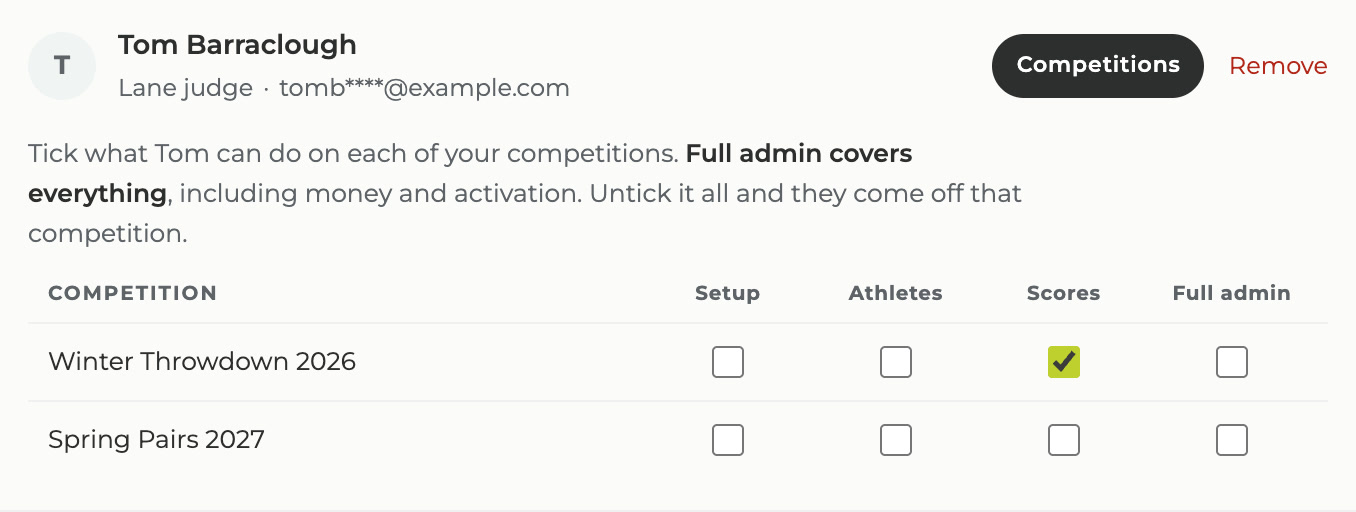
On Team Aretas you set how many judges you need when you edit the competition, and the competition page asks athletes to volunteer. You approve each one and choose what they can reach, for example Submit Scores and nothing else, and judges then enter scores from a phone or a laptop as each heat finishes. Judges you work with at every event go on the Your Team tab of your organiser profile, where you put them on each competition with just the Scores box ticked: