Running a competition to time
Every competition runs late somewhere. The ones that finish on time are not the ones where nothing went wrong; they are the ones that planned where to get the time back, called every heat early, and told athletes before they had to ask.
This guide works it through on the example every Team Aretas resource uses: 120 athletes, 8 lanes, one day, with 45 heats from 08:30 to 19:40.
The short answer
- Build the buffers into the plan: the two 20-minute resets and the gap before the awards hold 75 minutes between them.
- Call every heat three times: to warm up, to the holding pen and onto the floor.
- Recover in the resets, not in the changeovers, and tell athletes as soon as you are 10 minutes behind.
The worked example
The throwdown from the run of show: three workouts, 15 heats each, every heat in a slot of its time cap plus a 4-minute changeover:
| Workout | Slot | Runs |
|---|---|---|
| Workout 1 | 14 min | 08:30 to 12:00 |
| Workout 2 | 16 min | 12:20 to 16:20 |
| Workout 3 | 12 min | 16:40 to 19:40 |
Awards are at 20:15. Every heat waits for the one before it, so a minute lost on a heat is a minute lost on every heat after it.
Where the time is
There are three places a day can absorb a delay, and you should know how much each holds before the doors open:
| Buffer | Time | What it costs to use it |
|---|---|---|
| First reset, 12:00 to 12:20 | 20 min | Less time to change the floor, and a shorter judges' break |
| Second reset, 16:20 to 16:40 | 20 min | The same, before the heaviest lift |
| Before the awards, 19:40 to 20:15 | 35 min | Less time to check the final scores |
The changeovers are not on the list. Four minutes is what a lane needs to be cleared, reloaded and judged again, and a changeover cut short is where the wrong load goes on the bar.
Calling heats
Each heat is called three times, by the marshal, and each call is at a time the run of show already gives:
| Call | When | Heat 3 of workout 1 |
|---|---|---|
| Warm up | When the heat two ahead starts | 08:30 |
| Holding pen | When the heat before starts | 08:44 |
| Onto the floor | When the heat before hits its time cap | 08:54 |
| Start | Its own start time | 08:58 |
The call onto the floor happens during the changeover, so the next heat is standing at its lanes before the last one has left. That is where most of the minutes are won.
When you are 20 minutes behind
Say a broken rig holds up workout 1, and heat 7, due at 09:54, starts at 10:14. Here is what each fix gets back:
| Fix | Recovers | Cost |
|---|---|---|
| Do nothing | 0 min | Last heat finishes 20:00; awards at 20:35 |
| A 3-minute changeover for the rest of workout 1, except where loads change | 5 min | Less time to reset each lane |
| Cut the first reset from 20 to 10 minutes | 10 min | Judges' first break halved |
| Cut both resets to 10 minutes | 20 min | Back on time for workout 3 at 16:40 |
Cutting both resets is the usual answer: workout 2 starts at 12:30 instead of 12:20, finishes at 16:30, and workout 3 starts on time. Only the shorter changeovers touch the heats themselves, and they are the last thing to reach for, because the three heats where loads change (heats 8, 10 and 13) keep their full 4 minutes and the rest only give back a minute each.
Telling athletes
- Under 10 minutes behind, the MC says so and nothing else changes. Athletes already in the building go to the holding pen when they are called.
- At 10 minutes behind or more, update every time still to come. Put the new times on the board in the holding pen, and have the MC read out the next three heats.
- Tell the categories still at home. The Rx men are not on until 11:18; a message that says 11:38 saves them warming up for 20 minutes in a car park.
- Never start a heat early to catch up. Athletes plan their warm-up around the time they were given.
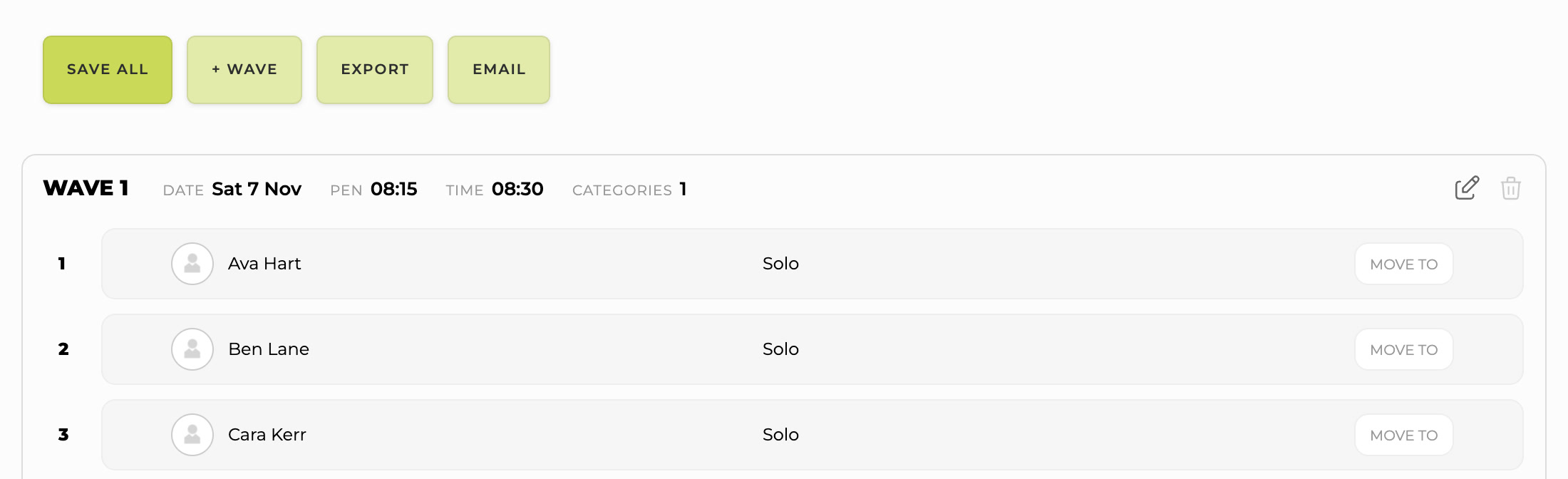
In a waves race the same rule holds with a tool to help. Re-time the waves that have not started, then email every athlete in them their new start time:
Common mistakes
- No buffers in the plan. A day planned to the minute has nowhere to put a broken rig except the end of the day.
- Calling a heat when the floor is empty. The heat then walks on during its own start time, and every heat after it starts late.
- Shortening changeovers first. It saves a minute a heat and costs the one heat where the wrong load goes on.
- Saying nothing until you are an hour behind. By then athletes have warmed up twice and the spectators have left.
Run it on Team Aretas
Team Aretas lays out every heat and wave with its start time, and athletes see their time once you publish the schedule. In a waves race, you can change the time of any wave that has not started and email the athletes in it their new start, and athletes can be notified when their heat or wave changes.