How to sell out a fitness competition
Most organisers expect entries to build slowly and rush in at the end. The data says the opposite: the launch is the biggest week a competition has, and the last week is one of the quietest. This guide uses sign-up data from more than 600 competitions to show when entries arrive, then turns it into a plan from the announcement to the day entries close.
The plan uses the example every Team Aretas resource uses: 120 athletes, 8 lanes, one day, with entries open 16 weeks before the event and closing 2 weeks before.
The short answer
- The launch sells the event. About a third of entries arrive in the first week, so have everything ready before you open.
- After that, entries come in steadily, a few a week. Give athletes a reason to look every week or two: workout reveals, the early bird deadline, the people and the prizes.
- Do not count on a late rush. The final week before entries close brings about 3% of a competition's entries.
What the data says
These figures come from 613 finished competitions on Team Aretas with at least 30 entries, 46,494 entries in all, counted from the first entry to the day of the event. Each figure is the median, the middle competition, so half did better and half did worse. They are totals across every organiser, and no single competition can be picked out of them.
Here is how the middle competition sold:
| Measure | The middle competition |
|---|---|
| Time from the first entry to the event | 14 weeks |
| Entries in the first 24 hours | 10% |
| Entries in the first 7 days | 31% |
| Half of all entries in | 18 days after opening |
| Entries in the final 7 days before entries close | 3% |
| Total entries | 53 |
The launch is also where competitions differ most. The middle half of them sold between 15% and 52% of their entries in the first week; after that, almost every competition settles into the same slow, steady pace.
How long to sell out
The competitions that sold out their tickets took a median of 81 days from the first entry. Selling out is the result of a good launch followed by weeks of steady sales.
When athletes sign up
Thursday and Friday bring a third of all entries (33%) and Saturday the fewest (11%). Through the day there are two peaks: 09:00 to 11:00 brings 16% of entries and 19:00 to 21:00 another 16%, as athletes book before work and after training. Post, email and open entries in those hours, when athletes are already looking.
The worked example
Entries open 16 weeks out with an early bird, and close 2 weeks out, a selling window of 14 weeks. Keep the early bird to 10% off at most. It is there to bring entries forward, not to cut the price. If the event fills, and entries follow the average curve from the data, the 120 places go like this:
| Weeks out | What happens | Entries so far |
|---|---|---|
| 16 | Entries open, with the early bird | 0 |
| 14 | 49 | |
| 12 | 63 | |
| 10 | 75 | |
| 8 | Early bird ends; workout 1 released | 86 |
| 6 | 98 | |
| 4 | Workouts 2 and 3 released; team change deadline | 110 |
| 2 | Entries close | 120 |
The first fortnight sells 49 places. Every fortnight after it sells about 12, which is 6 a week, and that pace hardly changes for three months.
Reading it backwards
The steady weeks are reliable, but they are slow. Twelve weeks at 6 a week adds about 71 places, so a full house needs roughly 49 in the launch fortnight. If the first fortnight sells 30, the same steady weeks take you to about 100. That is why almost everything in this guide is about the launch, and about stopping the weeks after it from going quiet.
Before you open
A third of your entries arrive in the first week, so anything that is not ready at launch costs you more than it would at any other time. Have these settled before the link goes out:
- Categories and prices, including the early bird price and the date it ends.
- The date, the venue and the shape of the day, even if heat times come later.
- The workout plan: how many workouts, and the date each will be released.
- The refund and withdrawal policy, and the waiver.
- Team rules: team size, and the date teams can stop changing members.
- A competition page with real photos, and a description that says who the event is for.
Announce the date before you open
Tell people when entries open, a week or two before. An announcement with a date gives athletes something to wait for, gets friends talking about entering together, and turns the launch into an event rather than a link that appears without warning. Ask people to register their interest, so you can tell them the moment entries open.
The launch week
Most of your entries this week come from people who already know you. Reach them first, in this order:
- Last year's athletes, by email, before anyone else. They have done it before and they are the most likely to enter again.
- Your own gym and the host gym, in person and in the members' group, the same day.
- Partner gyms, with a message their coaches can forward.
- Social media, with the date, the categories, the early bird deadline and the link.
Open on a weekday evening or morning, when entries arrive in the data. Thursday evening suits most events: 19:00 to 20:00 on a Thursday is the busiest hour of the week for entries, and it leaves the weekend for friends to agree a team.
Keeping it moving
After the launch fortnight, each week brings a few entries whatever you do. The organisers who sell out give athletes a new reason to look every week or two, so the competition keeps reappearing in their feed. A plan for the worked example:
| Weeks out | Reason to post |
|---|---|
| 16 | Entries open, with the early bird |
| 14 | Who each category is for, and the standard it asks |
| 12 | The venue, the shape of the day and the prizes |
| 10 | Two weeks left on the early bird |
| 8 | Early bird ends; workout 1 released |
| 6 | The judges, the sponsors and the prizes |
| 4 | Workouts 2 and 3 released; team changes close |
| 3 | One week left to enter, and how many places remain |
| 2 | Entries close; heats published |
Revealing the workouts
Release the workouts one at a time rather than all at once. Each release is a reason for every athlete who has entered to share the competition, and for everyone who has not to look at it again. Release each one with its standards, a video of the movements and a social media post, and keep the ones still to come visible as a date, so athletes know when the next one lands.
Gym partnerships
Coaches are the best salespeople a competition has: their members trust them, and a gym that enters together brings a team, not one athlete. Ask a few gyms within an hour of the venue to be partners:
- Give each gym its own discount code. Their members get a small saving, and you can see exactly how many entries each gym brought.
- Give the coach something to forward: a short message with the date, the categories and the code.
- Invite each gym to enter a team, so the gym has its name on the leaderboard.
- Thank the partner gyms on the day, by name, and offer them the same code next year.
Paid adverts
Don't start with adverts. Build a following for the competition first: the platforms then know who your athletes are, so an advert reaches the right people and costs less. Run them after the launch, when the people who already know you have entered and the steady weeks need new faces. Target people within travelling distance of the venue who train at a gym or follow fitness competitions, and show what the day looks like: last year's photos and video sell better than a poster.
Judge an advert by what it sells, not by its clicks. Divide what the advert cost by the entries it brought, and compare that with the entry price. That needs each sale reported back to the advert that brought it, which is what the Meta Pixel and the Meta Conversions API do: the Pixel reports from the athlete's browser, and the Conversions API reports from the server, so the sale is still counted when a browser blocks the Pixel. Both only report athletes who have agreed to advertising cookies.
The final push
The last week before entries close brings about 3% of a competition's entries, around 4 places in the worked example. The final push is for filling the last few places, not for rescuing a slow launch. Say exactly how many places are left and when entries close, and only say it while it is true: "8 places left, entries close on Sunday" works because athletes can check it.
Common mistakes
- Opening before the page is ready. A third of your entries arrive in the first week; a missing category or price costs most then.
- Opening without warning. A link that appears one evening has nobody waiting for it.
- Going quiet after the launch. The steady weeks only stay steady while athletes keep seeing the competition.
- Releasing every workout at once. Three reveals give athletes three reasons to share; one gives them one.
- Saving the effort for the last week. It brings about 3% of entries, whatever you do.
- Places left that are not. Athletes notice, and stop believing the next post.
Run it on Team Aretas
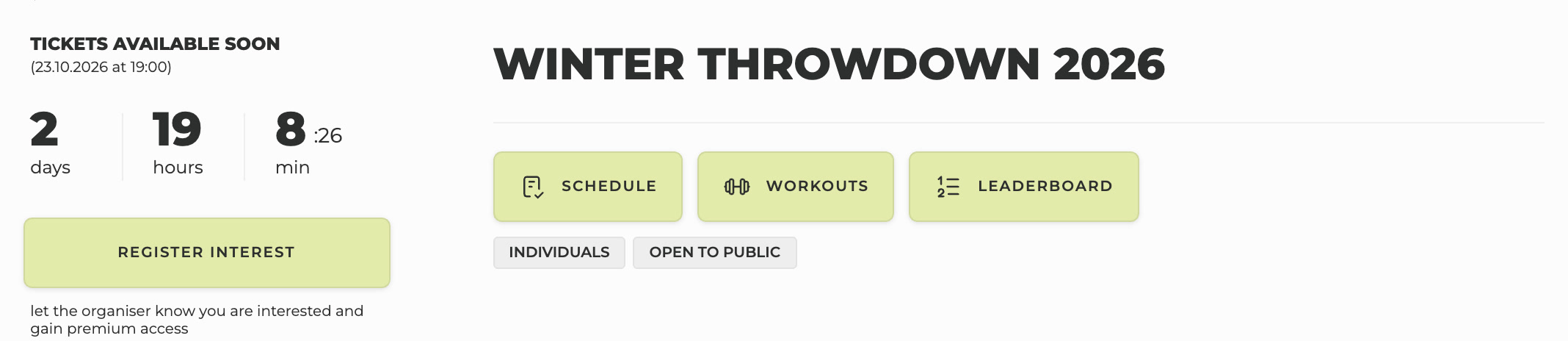
On Team Aretas you can set the date tickets go on sale, and the competition page counts down to it with a button for athletes to register their interest. They are notified 24 hours, 1 hour and 10 minutes before entries open, and again when they do. Workouts can stay hidden until their release date, showing only when they will land, and each entrant is emailed as each one is released (on a team, the captain). An early bird or a partner gym's code is a discount code with a usage limit, and each code shows how many times it has been used. On every plan except First Competition you can connect your Meta Pixel and the Conversions API, so each sale is reported to the advert that brought it: