Heats or waves: which competition schedule fits?
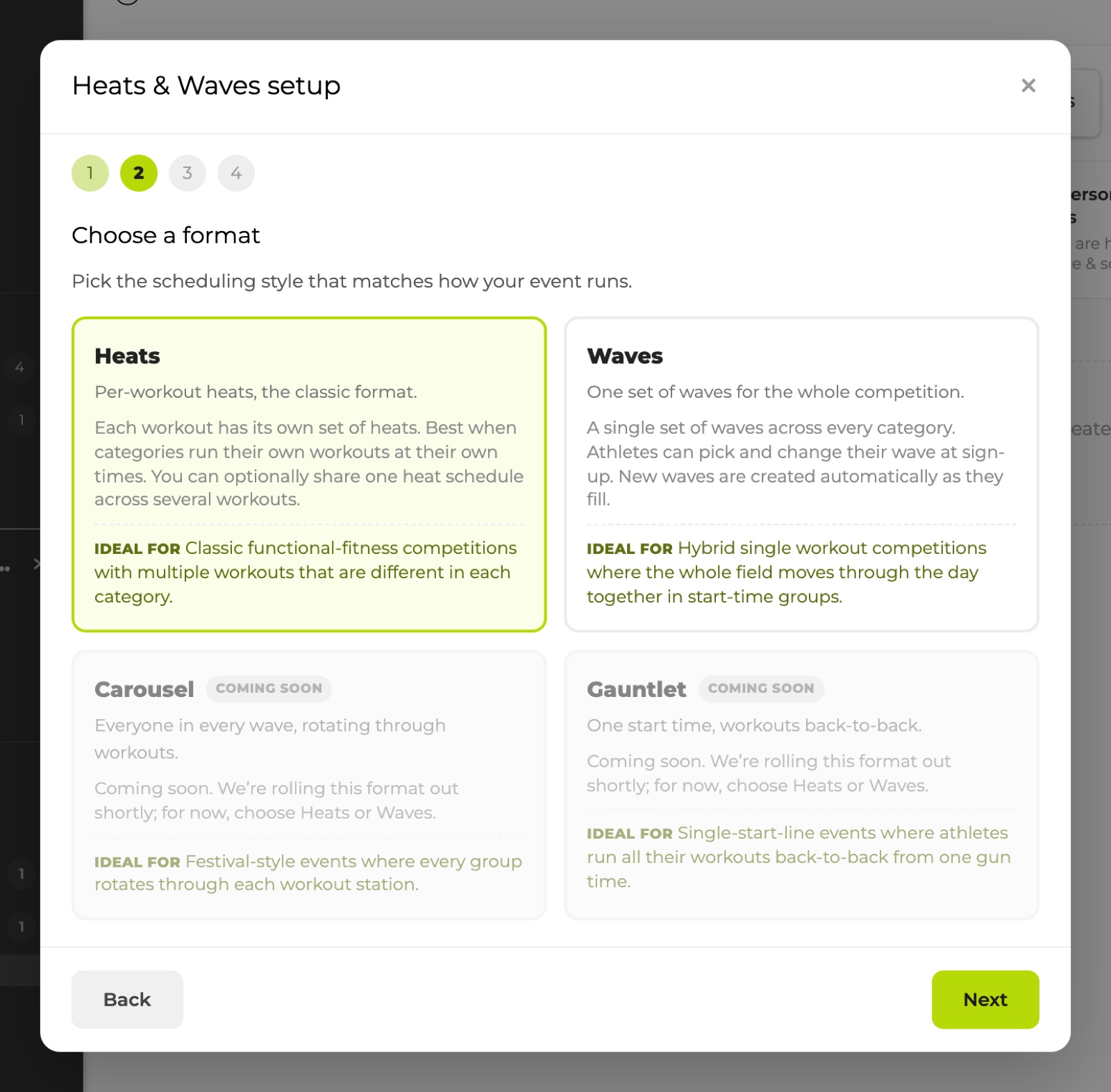
There are many ways to schedule your competition; here, we'll focus on the two most common ways to run a fitness competition day. Heats put every athlete through each workout in small groups, one workout after another. Waves send the whole field through one race in start-time groups. Which fits depends mostly on how many workouts you have, and the numbers decide it faster than any rule of thumb.
This guide runs the same competition both ways, with the worked example every Team Aretas resource uses: 120 athletes, 8 lanes, one day.
The short answer
- Several workouts, and everyone does all of them: heats.
- One race or one long workout, such as a hybrid race or an erg race: waves.
- A heats schedule that does not fit the day: add lanes or drop a workout. Squeezing the changeovers saves less than you think.
The worked example
120 athletes, 8 lanes, doors at 08:00 and the first heat at 08:30. Every slot on the floor is the workout's time cap plus a changeover: the minutes it takes to clear the lanes, reset the kit and get the next heat in. Leave the changeover out and the day runs late from the second heat.
How a heats day runs
Every workout runs all of its heats before the next workout starts. With 8 lanes, 120 athletes is 15 heats per workout.
| Workout | Time cap | Changeover | Slot | Heats | On the floor |
|---|---|---|---|---|---|
| Workout 1 | 10 min | 4 min | 14 min | 15 | 3 h 30 min |
| Workout 2 | 12 min | 4 min | 16 min | 15 | 4 h |
| Workout 3 | 8 min | 4 min | 12 min | 15 | 3 h |
That is 10 hours 30 minutes of heats. Add a 20-minute reset between workouts to re-rig the floor and brief the judges, and the day looks like this:
| Starts | Finishes | |
|---|---|---|
| Workout 1 | 08:30 | 12:00 |
| Workout 2 | 12:20 | 16:20 |
| Workout 3 | 16:40 | 19:40 |
What that means on the day
- It is a long day. A last heat at 19:40 is past what most venues and most judges will agree to. This is the most common problem with heats, and it is a maths problem, not a running problem: it was decided the moment the caps and lanes were set.
- Athletes wait. Each athlete competes for about half an hour in total. An athlete in the first heat of every workout goes at 08:30, 12:20 and 16:40, with around four hours between each.
- Every lane needs a judge all day. That is 8 judges and a head judge, from the first heat to the last.
How to make it fit
| Change | Heats per workout | Last heat finishes | What it costs |
|---|---|---|---|
| As planned | 15 | 19:40 | |
| A second floor, 16 lanes | 8 | 14:46 | Twice the kit and 16 judges |
| Drop workout 3 | 15 | 16:20 | One less test of the athletes |
| Changeovers of 3 minutes, not 4 | 15 | 18:55 | 45 minutes saved, and every heat is rushed |
With 16 lanes the last heat is half full, so it is 8 heats, not 7.5. The changeover row is the one to notice: shaving a minute off every changeover saves 45 minutes over the day, because there are 45 heats, and it is the minute your judges use to reset the floor safely.
How a waves day runs
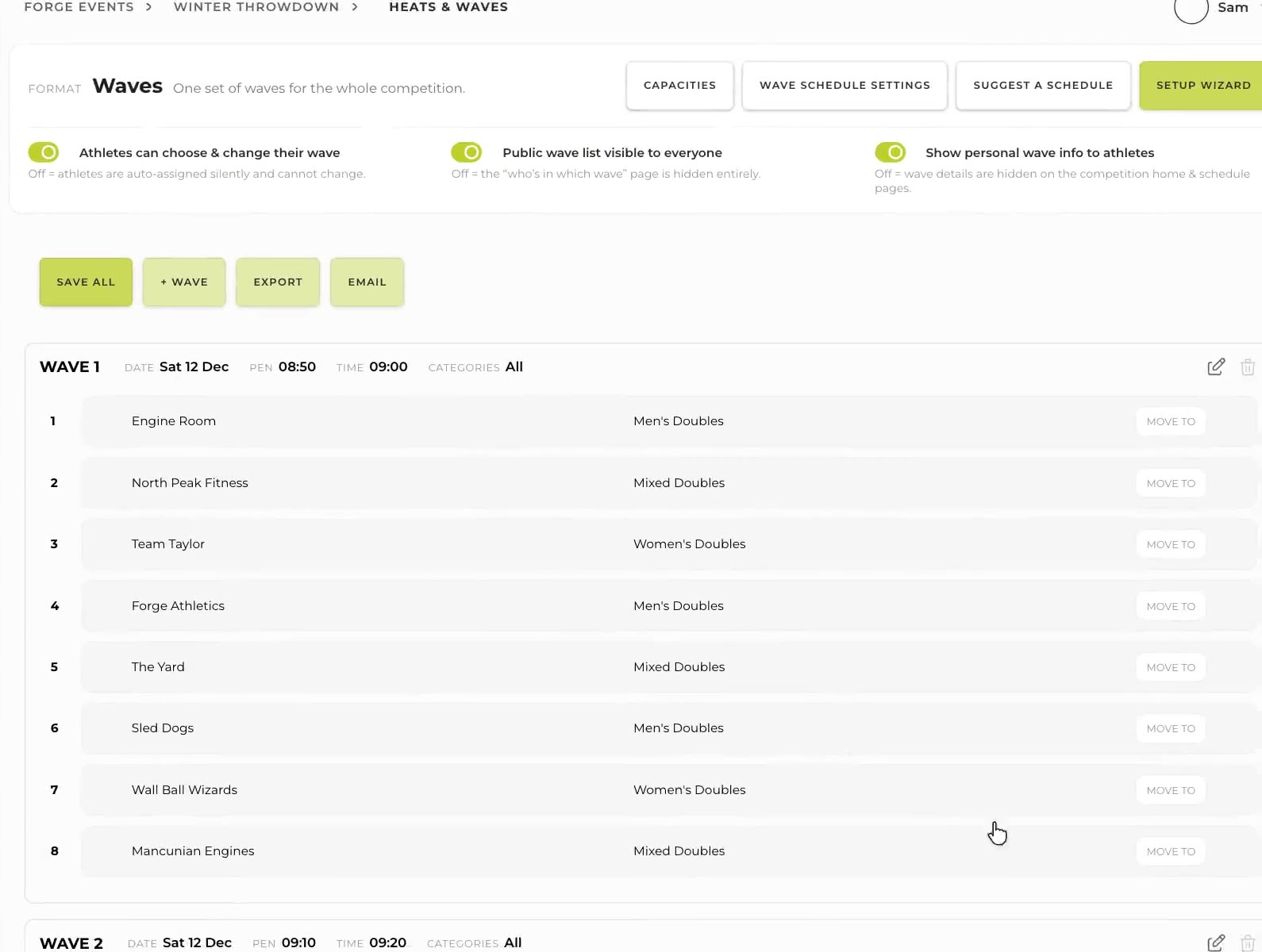
Everyone does one race, and the field sets off in groups. The group size is your number of lanes or stations: 8 rowers and 8 ski ergs means waves of 8, so 120 athletes is 15 waves.
A new wave can start as soon as the slowest station has room for it. That gap, the wave interval, decides the length of the day. Assume the race takes up to 90 minutes from start to finish:
| New wave every | Last wave starts | Last athlete finishes |
|---|---|---|
| 10 minutes | 10:50 | 12:20 |
| 15 minutes | 12:00 | 13:30 |
| 20 minutes | 13:10 | 14:40 |
What that means on the day
- The day is short and continuous. Even with 20 minutes between waves, the floor is clear by mid-afternoon, and something is always happening for spectators.
- Athletes come for their wave, not for the doors. They can be on site for a couple of hours rather than a whole day, and if you let them choose their own start time, friends can race together and people travelling far can start later.
- Judges stay at their stations rather than following a lane all day.
- The catch is that everyone does one workout. That is right for a race and wrong for a throwdown, where you want athletes ranked on several different tests.
Side by side
| Heats | Waves | |
|---|---|---|
| Best for | Several workouts, ranked on each | One race or one long workout |
| Group size | Lanes per heat | Lanes or stations per wave |
| The worked example | 45 heats, 08:30 to 19:40 | 15 waves, done by 12:20 to 14:40 |
| Athletes on site | Most of the day | Around their wave |
| Judges | One per lane, all day | At the stations |
| What sets the length of the day | Time caps, changeovers and the number of workouts | The wave interval and the race time |
Common mistakes
- No changeover in the slot. Ten-minute heats in ten-minute slots, with four minutes lost to every changeover, put the fifteenth heat of a workout an hour behind.
- Counting lanes you do not have kit for. Eight lanes but six rowers is a six-lane workout: 120 athletes becomes 20 heats, not 15.
- Fixing heats before entries close. Heats follow the numbers. A category of 9 athletes on 8 lanes is two heats, one of them nearly empty, unless you combine categories in a heat.
- Waves closer together than the slowest station. If the sled push is the bottleneck, it sets the interval, however quickly the rest of the race moves.
Run it on Team Aretas
Team Aretas builds either schedule from these same numbers. Choose heats or waves, enter your lanes, time caps and changeovers, and it lays out every heat or wave. You can move any heat, lane or athlete afterwards, let athletes choose their own wave where you allow it, and everyone affected is told when something changes.