How to organise a fitness competition: the complete guide
A fitness competition is a hundred small jobs, and almost every one of them is easy. What goes wrong is the order: a price set before the costs are known, heats published after athletes have booked their travel, a refund policy written after the first refund request. This guide puts the jobs in order, from six months out to the week after, and links to the detailed guide for each step.
It follows one competition all the way through, the example every Team Aretas resource uses: 120 athletes, 8 lanes, one day.
The short answer
- Six months out, fix the four decisions everything else depends on: the date, the venue, the format and the number of places.
- Open entries 16 weeks out, with everything an athlete reads before paying already decided. About a third of entries arrive in the first week.
- Publish the heats two weeks out, and run the day from a minute-by-minute plan. Athletes book their travel around their heat time, and a day without a plan runs late.
The worked example
The competition this guide plans, decision by decision.
- Athletes: 120, in six categories.
- Lanes: 8.
- Format: three workouts, every athlete does all three, 15 heats of 8 each.
- The day: doors at 08:00, first heat at 08:30, last heat finished at 19:40, awards at 20:15.
- Entry price: worked out from the budget, not picked first. The money section below shows how.
- People: 17 on the day: 8 lane judges, a head judge, a heat marshal, 2 floor crew, a score desk, 2 at check-in, an MC and first aid.
And the countdown it runs to, in weeks before the day:
| Weeks out | Milestone |
|---|---|
| 26 | Date, venue, format and places fixed |
| 16 | Entries open, with an early bird |
| 12 | Workouts tested, staff and kit booked |
| 8 | Early bird ends, first workout released |
| 4 | All workouts out, teams final |
| 2 | Entries close, heats published |
| 0 | The day |
The competition planning checklist turns each of these into lines to tick, with a name against each one.
Six months out: the four decisions
Everything later depends on four decisions, and changing any of them after entries open costs you athletes. Make them first, and make them together, because each one limits the others.
The date
Pick a Saturday at least six months away, and check it against the other events your athletes enter: the big online qualifying season, other competitions within a couple of hours' drive, and the school holidays if you run a teens category. A clash with a bigger event in your area halves the field you can draw from.
The venue
The venue has to fit the format, not the other way round. For 8 lanes of functional fitness, check:
- Floor space for 8 lanes, a warm-up area, a holding pen for the next heat, the score desk and spectators.
- Height for a 3 m wall-ball target and a pull-up rig.
- A floor you can drop barbells on, or room to lay platforms.
- Access times: in by 06:30 to set up, and clear by about 22:00 after the awards and pack down.
- What the venue needs from you: the insurance it expects to see, the cover it requires, and whether first aid has to be on site.
Your own gym is often the right first venue. If it is too small for 8 lanes, a smaller field with fewer lanes is a better first event than a larger one in a hall you cannot fill.
The format
The format decides how the day is built. Heats run the workouts one after another, each workout split into small groups, and suits a classic throwdown where every athlete does every workout. Waves start groups through one long race, and suit a hybrid race. Heats or waves explains the choice with the numbers, and each format has its own playbook: the functional fitness throwdown, the hybrid race and the league across several gyms.
The example runs in heats: three workouts, 15 heats each, 45 heats in the day.
The number of places
Places come from lanes and time, not from how many people you hope will come. Every athlete takes one lane in one heat of each workout, so:
- Heats per workout = athletes ÷ lanes, rounded up. 120 athletes on 8 lanes is 15 heats.
- Time per workout = heats × slot, where a slot is the time cap plus the changeover between heats.
The example's three workouts have caps of 10, 12 and 8 minutes, each with a 4-minute changeover, so the slots are 14, 16 and 12 minutes:
| Workout | Slot | 15 heats take | Runs |
|---|---|---|---|
| Workout 1 | 14 min | 3 hours 30 minutes | 08:30 to 12:00 |
| Workout 2 | 16 min | 4 hours | 12:20 to 16:20 |
| Workout 3 | 12 min | 3 hours | 16:40 to 19:40 |
With a 20-minute reset between workouts, the last heat finishes at 19:40. That is a long day, and it is the reason 120 is the most this venue and these workouts can hold.
Categories
Split the places into categories athletes can choose between, and cap each one in multiples of 8, so every heat is full:
| Category | Athletes | Heats per workout |
|---|---|---|
| Scaled women | 24 | 3 |
| Scaled men | 24 | 3 |
| Masters women (35+) | 8 | 1 |
| Masters men (35+) | 16 | 2 |
| Rx women | 24 | 3 |
| Rx men | 24 | 3 |
Rx is the full prescribed version of each workout; scaled uses lighter loads and simpler movements. Scaled categories matter more than they look: most people entering their first competition belong in them.
Money and insurance
Budget the competition first, then work out the entry price from it. A price picked first, from what other events charge, is how an event can sell out and still lose money.
- List every cost: venue, kit hire, judges and staff, first aid, insurance, prizes and photography.
- Take off what sponsors will cover. Sponsors can cover named costs, such as the prizes or the photographer, so the entry price does not have to.
- Divide what is left by the places you expect to sell, not the places you have. Pricing for a full event of 120 leaves you a fifth short at 96.
- Add a margin for the costs you have not thought of yet, and for paying yourself.
That is your price. If it comes out higher than athletes in your area will pay, cut a cost or find a sponsor rather than lowering the price and hoping. Fitness competition budget: what it costs and how to price it works through every line.
Sort out insurance at the same time. Ask the venue what level of cover it requires, then ask your gym's insurer whether your policy covers a competition open to the public. If it does not, buy an event policy for the day, and check under-18s are covered if you run a teens category.
Then create the competition, in draft, and set up the account your entry money will be paid into. Payout accounts take time to verify, and it is better done now than the week you want to open entries. On Team Aretas, a draft competition's dashboard lists what is left before it can go live:
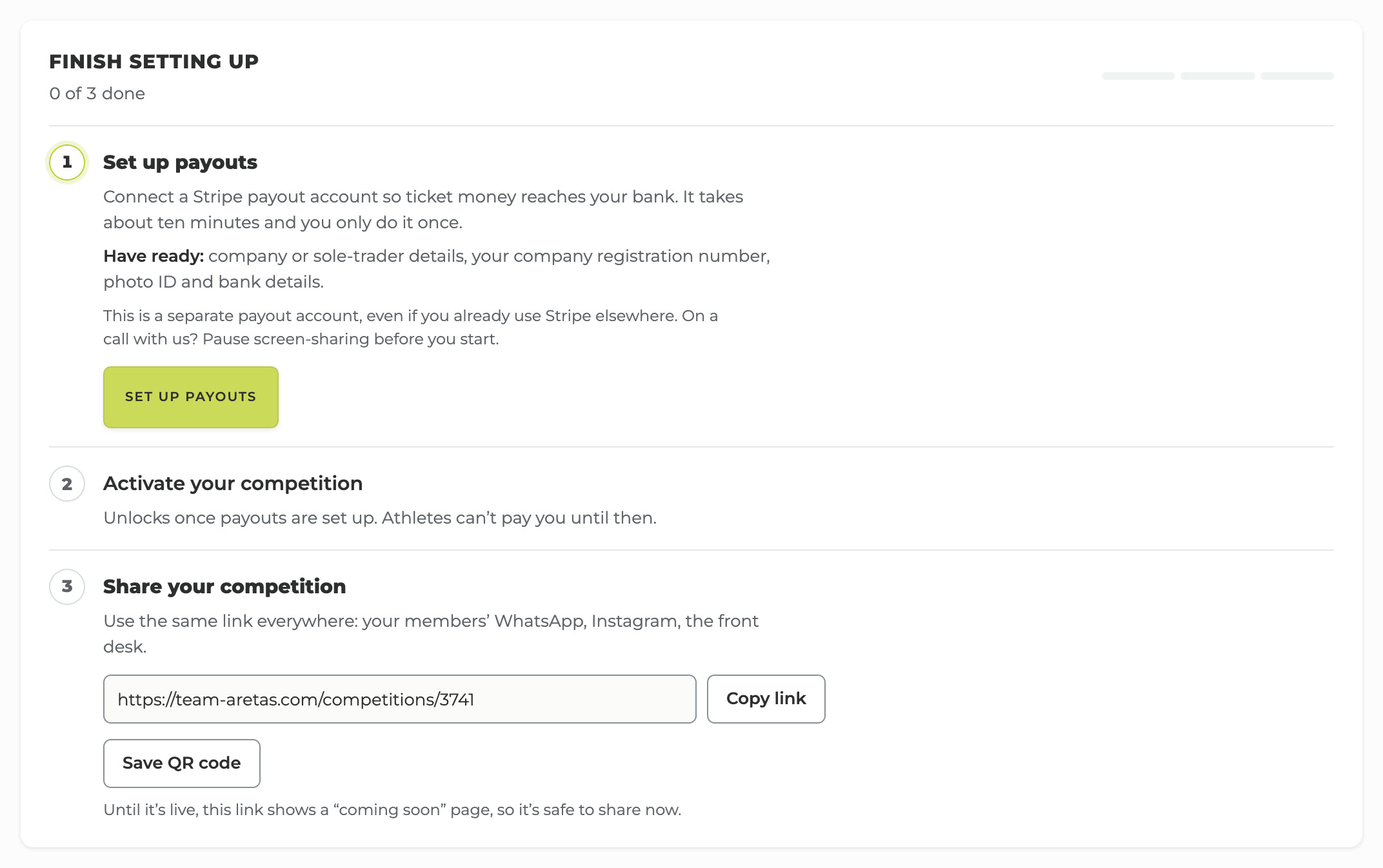
16 weeks out: open entries
About a third of a competition's entries arrive in its first week, so everything an athlete reads before paying has to be settled before the link goes out:
- The price for each category, and the early bird price, with the date the early bird ends.
- The refund and withdrawal policy. Say what you refund, until when, and whether an athlete can pass their place to someone else. The first athlete to ask for their money back sets your policy for you if it is not written down.
- The waiver, covering the risks of competing, the athlete's own health, and photos and video taken on the day. Have it checked by someone qualified to; a template is a starting point, not legal advice.
- Team rules, if you run pairs or teams: team size, and the date teams can stop changing members.
- The workout plan: how many workouts, and the date each will be released.
Announce the date entries open a week or two before, so athletes are waiting for it, then open on a weekday evening and tell last year's athletes first. If the example fills on the average curve, it has 49 entries after the first fortnight and about 6 a week after that. How to sell out a fitness competition has the data behind those numbers and a plan for every week of it.
This is also the week to start two longer jobs: recruiting judges, and contacting sponsors with the date and the numbers you expect.
12 weeks out: workouts, kit and people
The workouts decide the kit, and the kit decides the floor. Write the three workouts, then test each one on athletes from every category, timing them:
- Check every time cap fits its slot. A workout that takes most athletes longer than its cap is the wrong workout, not a long one.
- Check the scaled version is possible for everyone in a scaled category. A scaled athlete stuck on one movement for the whole cap has not had a competition.
- Write the movement standards: where each movement starts and finishes, and what is not a rep. The judges' pack has the template.
From the workouts, list the equipment. For the example's 8 lanes that is 24 wall balls in three weights and their targets, 8 boxes, 18 barbells, enough plates for the heaviest lift and a pull-up rig with 8 stations. Book whatever you do not own now, with a delivery time on the day before.
Then book the people. The example needs 17 on the day, or 27 with two crews of judges and two spares:
| Role | People | Job |
|---|---|---|
| Lane judges | 8 | Count reps and call no-reps, one per lane |
| Head judge | 1 | Briefs the judges, rules on disputes, signs off scores |
| Heat marshal | 1 | Calls each heat to the holding pen |
| Floor crew | 2 | Change loads and kit in each changeover |
| Score desk | 1 | Enters each score as it is signed |
| Check-in | 2 | From doors at 08:00 until the first heats are through |
| MC and music | 1 | Keeps the day moving and the crowd with it |
| First aid | 1 | All day |
Judges are the hardest to find and matter most to athletes. Recruiting and training judges covers where to find them, how many crews you need, and how to train them to call the same rep the same way.
8 weeks out: the first reveal
End the early bird on the date you promised, and release workout 1 with its standards, a video of every movement and a social media post. Releasing the workouts one at a time gives athletes something to train for and a reason to share the competition again, at the point where entries have settled into a steady few a week. In the example there are about 86 entries by now.
Confirm every judge by name and send them the standards, and confirm the kit hire and its delivery time.
4 weeks out: the field settles
Release workouts 2 and 3, and pass the team change deadline, chasing every team still short of members. The field is mostly fixed now, so the day can be built around it:
- Draft the heats, one category per heat, easiest first: the scaled women open the day in heats 1 to 3 and the Rx men close it in heats 13 to 15.
- Draw the floor plan: the warm-up area, the holding pen, the lanes, the score desk, spectators and first aid.
- Order your medals and prizes, or confirm the ones your sponsors are giving, and check when they will arrive: they take longer than anyone expects.
2 weeks out: heats published
Close entries and publish the heats, telling every athlete their heat time in each workout. Athletes book their travel around those times, so two weeks is the least notice that works.
Then write the run of show: every heat with its start time and the time it goes to the holding pen, the crew's morning, the resets and the evening. Send the staff rota, so everyone knows where to be and when, and have the head judge prepare the judges' briefing from the movement standards. The run of show and the judges' pack are both ready to copy.
Competition week
The last week is for checking, not deciding. Email every athlete with the doors time, check-in, their heat times, parking and what to bring, and send first-timers the guide to their first fitness competition, which answers most of what they will otherwise ask you. Check the kit against the list, test the clock and the music, print the score sheets or test every device the judges will score on, and confirm first aid, the venue's access time and the insurance certificate.
On the day
The day runs to the run of show. The outline:
| Time | What happens |
|---|---|
| 06:30 | Crew arrive, lanes numbered, kit out for the first heat |
| 07:30 | Judges arrive |
| 08:00 | Doors and check-in open; the judges' 20-minute briefing |
| 08:30 | Workout 1, heat 1 |
| 12:00 to 12:20 | Reset for workout 2 |
| 16:20 to 16:40 | Reset for workout 3 |
| 19:40 | Last heat finishes; scores checked and signed off |
| 20:15 | Awards |
| 22:00 | Venue clear |
The day holds 75 minutes of buffer: the two 20-minute resets, and 35 minutes between the last heat and the awards. Every heat that starts a minute late spends one of them, so call each heat three times, to warm up, to the holding pen and onto the floor, and keep the changeovers to their 4 minutes. Running a competition to time shows what to do when the day slips anyway.
Scores go in as each heat is signed. Most competitions add up each athlete's place in every workout and the lowest total wins; fitness competition scoring explains the methods and how ties are broken.
The week after
The week after is when next year's entries are won or lost:
| When | What |
|---|---|
| The same night | Final results published, once the head judge has signed them off |
| Day 1 | Thank-you email to every athlete, with the results and a short survey |
| Day 3 | Photos published |
| Day 5 | A report to every sponsor |
| Day 7 | Debrief with the head judge and staff; survey closes |
| By day 14 | Next year's date announced, and the early bird opened to this year's athletes first |
After the event has the survey questions, the sponsor report and the debrief ready to use.
Common mistakes
- Choosing the number of places before the venue. Places come from lanes and time; 120 needs 8 lanes and an 11-hour day.
- Opening entries before the refund policy and waiver are written. A third of entries arrive in the first week, all of them under rules you have not set.
- Workouts that do not fit their slots. One workout running two minutes over in every heat adds 30 minutes to the day.
- Exactly enough judges. One no-show and a lane has no judge.
- Publishing heats the week before. Athletes have already booked travel around a guess.
- Going quiet after the awards. Next year's early bird sells best while this year's athletes are still talking about it.
Run it on Team Aretas
Team Aretas runs the whole countdown in one place. You build the competition in draft and activate it when you are ready, with categories carrying their own prices and caps, a waiver every athlete signs before paying, and entry money paid into your own Stripe account with no Team Aretas fee per athlete. Workouts release on their dates, the heats are published to every athlete, and on the day check-in, scoring and the live leaderboard run from the same place.